What is shown
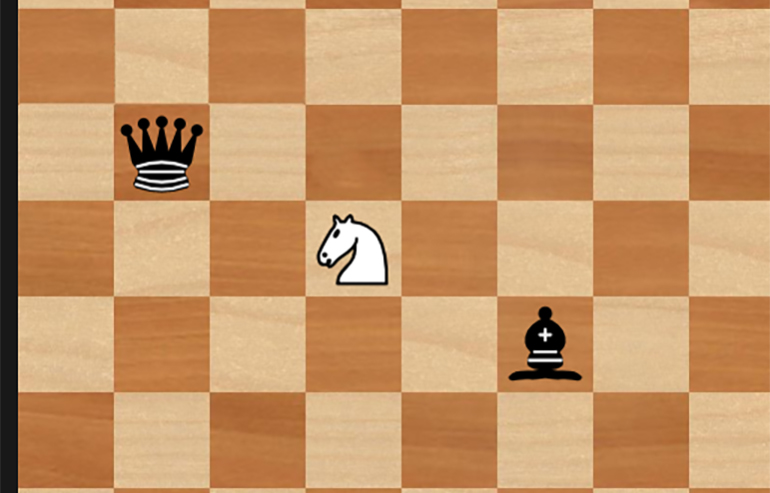
The picture shows part of a board with a wooden texture and alternating light and dark squares. In the center stands a white knight; to the left and above it is a black queen, and to the right and below it is a black bishop with a white cross on its top. The left edge is cut off by a dark strip, the top and bottom rows are only partly visible, and there are no captions on the image.
If you count the squares, the queen stands two squares to the left and one up from the knight, and the bishop two squares to the right and one down. Both distances are exactly a knight's move. This means the knight attacks both black pieces at once, and neither the queen nor the bishop can capture it from where they stand.
What a fork is
In chess, a fork is a situation where one piece attacks two or more of the opponent's pieces at the same time. As a rule, it is not possible to defend both targets with one move, so the opponent loses something. The knight is considered the most dangerous master of the fork, because its L-shaped move does not resemble the moves of other pieces, and the threat from it is easy to underestimate.
The stakes in this image are especially high: the queen is worth roughly nine pawns, the bishop roughly three. If the queen moves out of attack, the knight takes the bishop; if the bishop is saved, the queen can be lost. That is why this position is often shown as an example of an unexpected turn.
How the knight moves
The knight moves in an L shape: two squares in one direction and one square at a right angle. It is the only piece that can jump over others, so its threats cannot be blocked by placing something in its path. With every move it changes the color of the square it lands on: from light to dark and back.
This is convenient for jokes: the knight literally “arrives from an unexpected side,” and a viewer used to straight lines does not notice the threat right away.
Where the image comes from
The origin of this image as a meme is unknown: the dated first publication and the author are not known. The pieces here are drawn in the style of simple online chess, but it cannot be determined which program the screenshot belongs to.
This matters for an honest description: the template can be used as an illustration of a chess theme, but it should not be presented as a well-known format with a history, or attributed to nonexistent authors.
Caption examples
Below are invented captions. The knight here can be captioned as a person who creates two problems with one action.
Above the queen: “Deadline.” Above the bishop: “Weekend plans.” Above the knight: “Urgent favor from the boss on Friday.” The joke works because the request threatens both work and rest at once, and only one of them can be saved.
Above the queen: “Budget.” Above the bishop: “Conscience.” Above the knight: “Sale ends today.” Here the fork becomes an image of having to choose between two unpleasant decisions.
Above the knight: “I have one question on the exam.” Above the pieces: “The tickets I studied.” This caption shows that one unexpected question can ruin all the preparation.
How to use this template
The picture suits jokes about a fork in life circumstances: when one piece of news or one request threatens two plans at once. It works best when the pieces are captioned by role: the attacker and the two victims. Long explanations get in the way, because the idea is already visible from the position of the pieces.
If the image is used in a conversation about chess, it is worth remembering the rules: the knight cannot capture pieces along a straight line, and the fork disappears if one of the attacked pieces can capture the knight itself or defend with a strong counter-move.