What is in the drawing
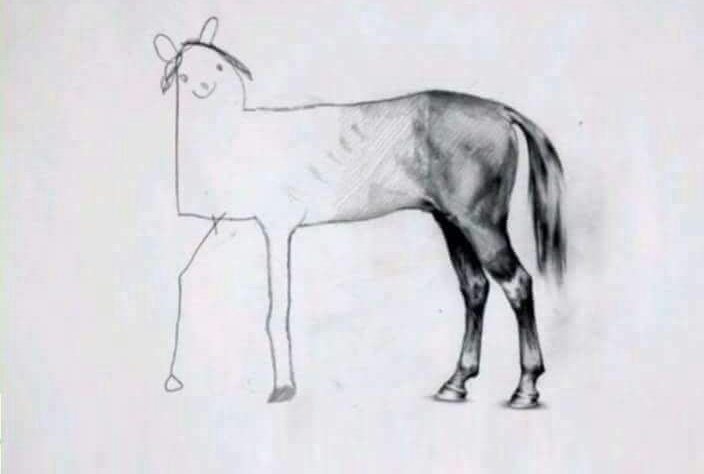
The drawing is done in pencil on light paper. The front half of the horse is a simplified child-like outline: a square torso, straight little legs, a head with two ears, a smiley face, and a careless forelock. One of the front legs is drawn with a thin line and a little loop in place of a hoof. The back half is entirely different: the muscles, shading, and volume are carefully worked out, the tail is soft, and the hooves are drawn in detail.
The boundary between the two styles runs right across the body, so it looks as if the drawing was started with one hand and finished with another. It is exactly this sharp change that makes up the point of the picture.
Where the drawing came from
According to reports, the original illustration was created by artist Ali Bati for an advertising campaign of an art school. It showed the difference between an unskilled and a professional drawing within one picture. In March 2018 the image appeared on Reddit with a caption about the last five minutes of an exam, and after that it spread across the internet.
The original purpose of the advertisement is almost unrelated to the meme: in the joke, the drawing became an image of work that gets done in a rush. This is an example of how viewers find their own meaning in a picture.
How the joke reads
The drawing is convenient to read from left to right: first carefully, then worse, though in fact it is the other way around, since the part with the tail looks better. The joke works in both directions. Some read the realistic half as the “beginning,” when there was still energy, and the child-like half as the “hasty end.” Others do the opposite: they caption the good half with what was done long ago, and the bad half with what gets finished at the last minute.
The main thing is the contrast itself. Any situation where one part is done with care and another part is done anyhow fits this template.
The template is convenient because it allows “before and after” captions: the two halves of the drawing correspond to two parts of one piece of work. It suits stories about projects, cleaning, renovation, diets, and studying, where the start comes easily but the finish is rushed.
Examples for your own caption
“Introduction and first chapter of the thesis / the last five pages at night before the deadline” — a classic student joke.
“First week of the new routine / second week” — a drop in motivation over time.
“Tidying the room: everything in sight is perfect / the closet behind the closed door” — two halves of one task.
“Start of the series / finale of the last season” — a variant for a conversation about the quality of a sequel.
How to use it
Caption the two halves of the drawing separately — the careless head and the neat tail — or compress the contrast into one line without tying it to parts of the body. It works well when the situation gives a clear “was — became,” as in the examples with the thesis or the series.
The drawing works well without extra words: an overloaded caption distracts from the main idea. The best jokes with it are very short and immediately suggest a comparison.
For the topics mentioned above — studying, cleaning, renovation, diets — it is enough to replace the words in brackets in the “before/after” examples: the ready template “first part / second part” works without extra explanation, because the contrast is visible at once.