Two uploads of one delight
The format is tied to Twitch and to additional emote libraries for its chats. The upload of POGGERS to BetterTTV is dated February 23, 2017. Another notable trace is a user named Klotzi's upload to FrankerFaceZ on September 24 of the same year. These are different distribution platforms for one recognizable face. The Klotzi version entered the FrankerFaceZ library when the image was already spreading through BetterTTV. That user's name is tied to this particular emote upload.
By the end of 2017 the word was being discussed beyond direct image exchange, including in communities around League of Legends. In early 2018 explanations appeared for people who encountered it in chats. Poggers is close in function to PogChamp, a human emote of surprised excitement. However, the green frog is an independent image: no real person's face appears in it, and the resemblance lies primarily in the character of the reaction.
Eight samples, one face
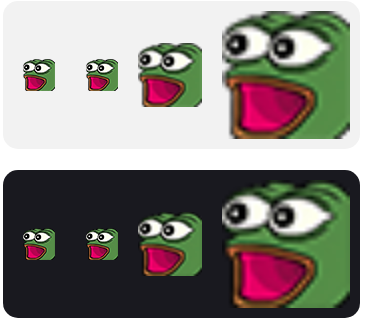
The image shows a size table: four pictures on a light strip at the top and four on an almost black strip below. In every case it is the same green face with huge white eyes, dark pupils, and a bright pink inner mouth. On the right is the largest variant, where pixels are especially visible. The two strips demonstrate how the emote looks against different backgrounds; they do not depict a change of mood, a developing story, or a meeting of several frogs.
A quick reaction to a good moment
The emote allows a response faster than formulating a separate congratulation. When something spectacular happens on stream, several identical green faces signal the viewers' shared excitement. The wide mouth makes the reaction loud even without sound, and the upward gaze heightens the impression of a sudden spectacle. Understanding it does not require knowing who won: the stream provides the specific event, and the image conveys the chat's attitude toward it.
The word poggers can carry this function into ordinary messaging. Writing it after good news means replying in the tone of a gaming chat. However, not every open mouth means delight: the habitual use of the specific emote plays the decisive role. In the ironic version the positive reaction is deliberately excessive, because the achievement is trivial or the situation too mundane for such a wild celebration.
Joy at three scales
First fictional example: a streamer finishes a bridge in a building game a second before a friend's character falls into a chasm. The chat replies POGGERS. Here the reaction is direct: viewers saw a timely and spectacular move, and the repeated face becomes small shared applause.
The second fictional scene moves the emote into study chat. After several attempts, the group finally finds a meeting time that suits all five participants. One of them sends the green frog. The organizational success is compared to a rare team victory; the humor lies in how well a recognizable gaming delight fits the task of aligning calendars.
The third fictional story pushes the disproportion down to a household trifle: a person found the second sock right away without sorting through the whole laundry basket. A friend replies with a huge POGGERS and declares the event the main achievement of the day. The irony stays good-natured, because the good news is real; only the solemnity of its welcome is exaggerated.
When the picture becomes a word
The text poggers is recognizable even without the emote set installed. In this case it serves as a sign of belonging to stream culture: conversation partners supply the facial expression and complete it themselves. Sometimes it is the inappropriateness of such a reply that becomes the joke. An official announcement about new office furniture receives a reaction suited to defeating a difficult boss, and a dry piece of news momentarily turns into a stream event.