An underwater encounter
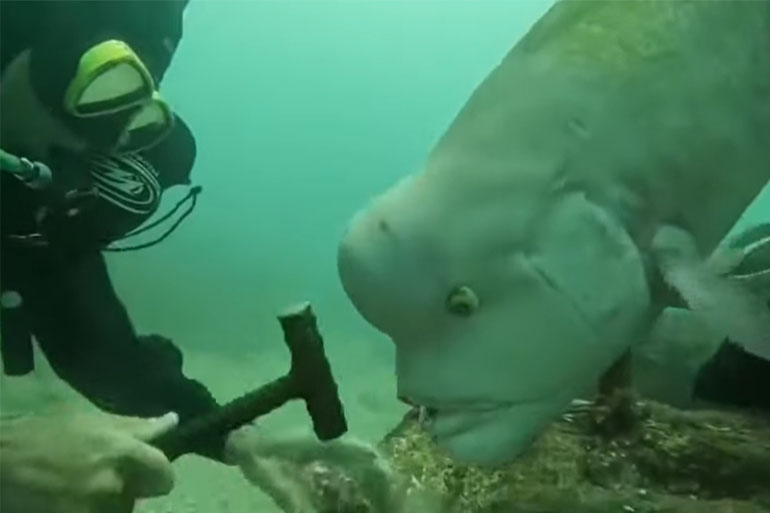
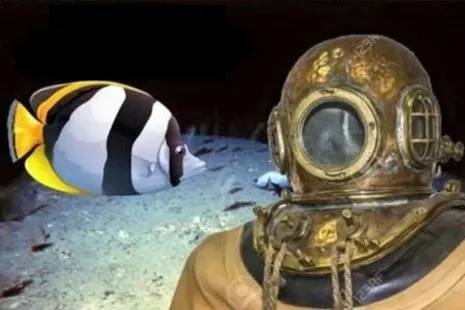
In the circulating video, a diver is next to a large sea fish; in a longer version he breaks open a mollusk shell while the wrasse stays close and watches him. The local picture in the catalog is a tight crop of the encounter, so the shell and the action itself are not fully visible. The fish has a massive head and prominent teeth adapted for crushing hard prey. Because of its unusual profile, the face looks almost human, especially in a close-up.
The frame quickly became a handy reaction image: the fish seems to be assessing the human's actions or waiting for an explanation. But the expression is a human reading of a motionless animal, not evidence of any particular feeling. Without the context of the full video, it cannot be established that the fish "disapproves" of the diver or understands his intentions. The meme relies on visual anthropomorphism, in which people credit an animal with human thoughts for the sake of a joke.
What is known about the fish
English-language descriptions use the name Asian sheepshead wrasse. In the current World Register of Marine Species, the accepted scientific name is Bodianus reticulatus; Semicossyphus reticulatus is listed as a former combination that the register treats as a synonym. The fish lives in the western Pacific Ocean. Adults can grow large, and the protruding teeth help them deal with hard-shelled invertebrates. These traits explain the shape of the head better than comparisons with humans do.
In online captions the fish is sometimes called "Yuriko" and linked to a particular diver, but the history of individual viral copies is often retold inconsistently. Until a reliable link between a specific source video and such a backstory is established, a name taken from retellings should not be treated as established fact. A description of the meme can name the species accurately while remaining uncertain about the origin of a particular recording.
How a brief stare became a reaction
The fish looks straight at the man but barely changes position. This creates a convenient pause for a caption: viewers can insert any situation in which someone silently watches a questionable decision. In an ordinary conversation a person would reply with words, so a mute stare becomes a universal sign of skepticism, patience, or mild shock.
The close-up keeps the emphasis even after cropping. If only the fish and the diver's face remain, the mollusk action can disappear, and the template starts working independently of the original scene. Captions often invent an inner monologue for the animal. These should be read as the author's own caption, not as words from the video or a scientific interpretation of behavior.
Examples for new situations
"Me: I'll just buy one cable. Cart: four adapters, a charger, and an organizer." The fish can stand in for a colleague watching a small purchase turn into a pile of accessories. The joke stays at an everyday level and does not require explaining the biology of the species.
"My friend explains that he's starting a new diet by ordering a third dessert." The caption turns the stare into a silent reaction. To avoid judging a specific person, you can aim the joke at yourself: "I'm telling myself this was the last dessert."
For a variation on the original scene: "When someone tries to open tough packaging without scissors and you already know how it ends." This keeps the situation of watching someone act without inventing the thoughts of a real fish.
A living animal is not a character with a ready-made diagnosis
Anthropomorphic captions can be a harmless artistic device, but they should not be confused with information about animal behavior. One look does not confirm contempt, friendship, jealousy, or recognition of a specific person. A scientific explanation should rely on the traits of the species and the circumstances of the recording, if those are actually known.
Likewise, do not claim without qualification that a popular video shows lawful or safe interaction with wildlife. A viral clip does not reveal the location, the filming rules, or the full sequence of events. For a meme article, it is enough to say what is visible in the frame, name the fish, and explain the visual mechanics of the joke.