A home photo with a long second life
The story of the full format is tied to a dog named Delmar and screenwriter Megan Ganz. In September 2012, Ganz posted a photo on Twitter showing a live dog sitting beneath a picture of a dog in a similar pose. The image spread through animal roundups long before it became a standard template for comparisons. The name of the painting's author and of the photographer has not been reliably established; Ganz's post does not allow automatically attributing both works to her.
The picture got a new life in March 2018 on Reddit. Users began labeling the two subjects separately: the painting was assigned the role of the original idea, and the dog the role of its repetition. A domestic coincidence turned into a scheme of relations between model and follower. This remake did not require changing faces or drawing a new action: it was enough to give two already similar poses different names.
A dog without a second participant in the comparison
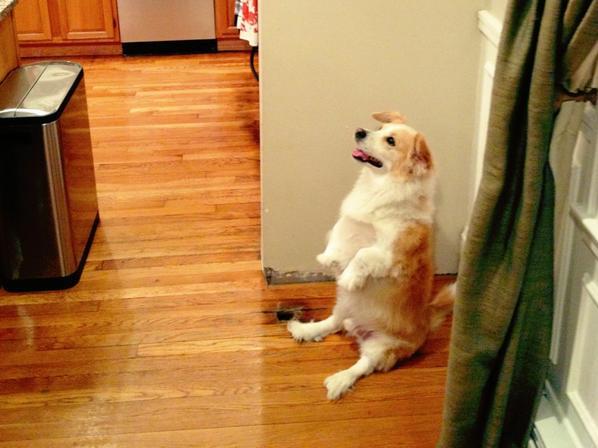
The fragment shown contains no painting. A white-and-ginger dog sits by a light wall on a wooden floor, its back legs stretched forward and its bent front legs raised. Nearby are a kitchen, a metal basket, and a dark curtain. Its head is turned to the side, with its tongue poking out of its mouth. The whole scene remains domestic, and the unusual upright sitting posture makes the animal look like a person trying to hold a complicated pose.
The meme's title helps mentally reconstruct the comparison, but the photo itself shows no one presenting the dog with a model. From a single image one cannot tell whether it was following a command, waiting for a treat, or simply settled that way. The meme role of the “copycat” is a reading of the coincidence, not proof that the dog understands painting. This distinction keeps the funny human interpretation without turning it into a story about the abilities of a particular animal.
The original, the copy, and recognizable effort
In the full composition, the image and the live participant work as a ready-made pair. One motionlessly embodies the desired form, while the other reproduces it awkwardly and very physically: with fur, weight, and the need to keep its balance. Captions can turn them into an expensive model and a cheap substitute, a good idea and a hasty remake, a beloved performer and a novice fan. The similarity of the poses lets you see the connection before you read any explanation.
At the same time, the copy doesn't have to be bad. In some skits, it is precisely the effort and the literalness of the imitation that are funny. A person saw a showy gesture and carried it over into a completely different setting, keeping the outer form but losing the original meaning. The fragment with a single dog is especially convenient for this role: the model can be named in the caption, and the raised paws already play the attempt to live up to it. The viewer laughs at the gap between the imagined confident pose and the visible effort.
Imitation in three invented scenes
“After one video of a conductor: I'm starting to conduct the kettle.” The raised paws become the hands of a novice maestro, and the familiar kitchen becomes his concert hall. It's funny that a solemn gesture is transferred to an object that would boil on its own schedule even without any conducting.
“Copying the sculpture's pose for a vacation photo while everyone else is figuring out where to put the bags.” Here the dog plays a diligently frozen tourist. The comparison happens between an imagined monumental portrait and an awkward real setup, hampered by the most mundane things.
“The trainer showed the stance for a second, and I thought that was the whole workout.” The dog looks like a person who has absorbed the outer form of an exercise and skipped the movement that should follow. This example mocks one's own oversimplification of what was seen: the copy is diligent, but it reproduces only the most visible fragment of the model.