what's in the picture
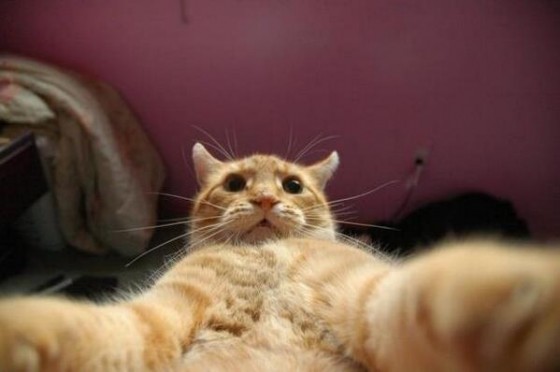
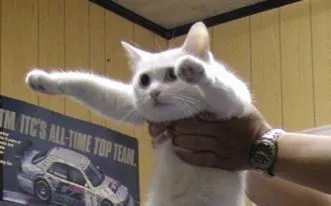
The photo is a close-up of a ginger cat that, judging by the angle, is very close to the lens. Its front paws are stretched toward the camera, its body fills the lower part of the frame, and its head is raised so that its gaze points directly into the lens. Its eyes are wide open, its whiskers spread out to the sides, and its facial expression looks both serious and a little tense.
The background is simple: a pinkish-lilac wall and a crumpled blanket on the left side of the frame. The composition resembles a selfie or a video held in someone's hand. That's exactly why the cat seems to be the one holding the camera and commenting on what's happening. The gaze into the lens creates the illusion of addressing the viewer, like a host opening a show.
The cat's visual seriousness contrasts with its ordinary behavior: the animal is simply lying stretched out, looking up. This gap between the important-looking appearance and the mundane situation is what makes the picture a convenient basis for a caption that casts the frame in the role of a host.
origin
The photo of the cat itself had been circulating online long before the joke appeared. The exact photographer and the date of first publication haven't been established in open sources. The project's catalog dates the meme to 2014, but it hasn't been possible to confirm the year when the cat was specifically paired with the parody caption.
The name and format riff on the opening of Johnny Knoxville from the MTV show "Jackass." The show aired from October 2000 to February 2002, and its opening became a recognizable calling card. A similar device — swapping in a name within a recognizable phrase — is well known from the snowclone "And Welcome to Jackass," which spread actively on Tumblr and meme sites in 2011 and then returned in 2022 alongside the release of "Jackass Forever."
The cat was cast in the caption as a host with a similarly-sounding name. This transfer of the format onto an animal shows how internet humor is happy to take familiar text and apply it to unexpected characters. The joke rests not on a specific author but on the recognizable structure of the phrase.
how the meme is used
A typical caption opens with a TV-host-style greeting and then moves on to an everyday situation. For example, users write that today they'll explain why the cat knocked a glass off the table, or that today's segment will cover why the cat is sitting in a box that's clearly too small for it. The tone of the caption is pointedly serious, which creates the comic effect.
The meme is most often applied to cat behavior: sudden nighttime zoomies, staring intently into empty space, trying to climb into a bag, or waking people up at five in the morning. The frame becomes a short video segment about how cat life works, and every viewer mentally fills it in with their own observations.
The template is easily transferred to other animals and even to people with similar habits. Users change the name, add a "show" title, and new storylines, but keep the main rule intact: a serious opening and a mundane punchline.
why the joke works
The meme runs on anthropomorphism. People are naturally inclined to see human traits in animals, and the gaze into the camera and the outstretched paws create the impression that the cat is confident in its role. When you add the standard host's catchphrase on top of that, it creates the sense of a parody of a TV format, and the humor registers instantly.
The recognizability of the behavior plays an important role too. Almost every cat owner has experienced situations that could be retold as "an episode of the show." The joke works as a quick confession: owners understand that their pet acts like a host, and the cat, for its part, looks as if it's in on the joke itself.
Another factor is brevity. A single phrase and a single frame are enough to get it, so the meme fits easily into a feed and needs no explanation. It's exactly this simplicity that lets the picture be captioned with endless different texts while staying recognizable.
spread
The meme spread through image macros on social media, on animal-themed pages, and in Russian-speaking communities, where the captions were translated and adapted to local everyday life. The picture's small size and expressive framing made it convenient to post in comments and in replies to cat-related posts.
As cat memes grew in popularity, the image of the ginger cat became established as a convenient character for ironic jokes. Over time, variants appeared with other "hosts" and other "segments," but the core stayed the same: a serious delivery paired with a mundane plot.
Today the picture is treated as a classic image of collective irony about cat nature. It's used even by people who don't know its origin, because the very idea of the "cat host" reads instantly and needs no explanation.