What's shown in the picture
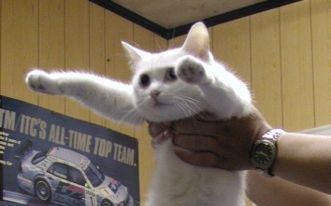
In the original photo, a white cat being held by the torso by someone's hand stretches its front paw forward and to the left. The cat looks straight into the camera, its face focused and slightly surprised. In the background, the edge of a poster showing a racing car and some text is visible, and in the bottom right corner a wristwatch on the person holding the animal can be seen.
In the most famous version of the meme, the cat's body is stretched dozens of times over. As a result the cat takes up an enormous height of the image, and its tail runs far off the bottom of the screen. This is exactly where the main joke lies: the animal looks as if it had been pulled vertically, while still keeping a calm, serious expression.
The picture is recognizable thanks to the contrast between the white cat and the dark background, as well as the obvious distortion. Even without a caption, the viewer understands that this isn't an ordinary photo of an animal but a deliberately distorted image made for comic effect.
Origin and history
The Longcat meme dates to roughly 2006. That's when the picture began spreading on forums and imageboards, where users shared photos of animals and photo edits. The author of the first stretched image, and the original photograph it was made from, haven't been fully established, so the origin remains unclear on that point.
Over time the picture became one of the early examples of how a simple photographic distortion can turn into a lasting internet meme. Rather than accompanying text, it became a standalone object of the joke that passed from one community to another. Each new version added fresh context to the original idea.
It's worth noting separately that Longcat belongs to the category of 'long' images that work as a visual device. Their point isn't the object itself but the action: the viewer is forced to scroll to see the end of the joke, and that very process becomes part of the humor.
How the meme is used
The main use case is posting the picture in comments or in chats as a joke about an overly long message, a long feed, or a dragged-out discussion. When someone drops in Longcat, they're hinting that the reply will be very long, or that someone is scrolling way too much looking for the right spot.
Typical captions are usually ironic: 'looking for where the cat ends,' 'scroll a bit more,' 'this isn't the end.' Sometimes the meme is used as a reaction to a huge wall of text or to an endless thread where every new reply makes the conversation longer, like the animal's body.
In a broader sense, Longcat has become a universal symbol for anything that drags on too long. It can be dropped in as a reminder of how annoying long pages are, as a joke about slow loading, or as an ironic illustration of a project that's gone on forever.
Why the meme caught on
The first reason for its popularity is the absurdity of the image. The animal looks ridiculous, yet it keeps a serious face, and that contrast makes the picture funny right away. The viewer doesn't need anything explained: it's clear the cat has been stretched, and imagination fills in the rest.
The second reason has to do with user experience. Almost everyone has run into long comments, endless feeds, and pages where you have to search forever for the part you need. Longcat turns that irritation into a joke, which is why the meme is easy to understand and accept.
The third reason is how easy it is to reproduce. The picture is easy to save, forward, and drop into any conversation, and its shape is recognizable even as a thumbnail. That's why Longcat has stayed in demand for many years and became one of the defining cat memes of the Russian-speaking internet.