What the image shows
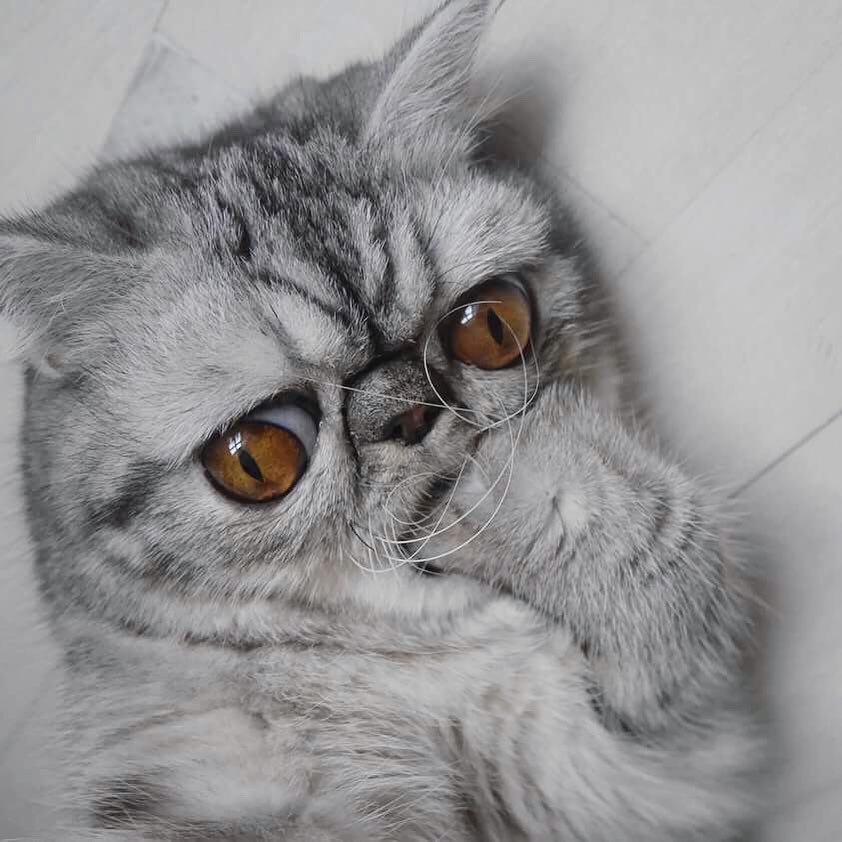
In the photo, a gray tabby cat with a short flat face and large orange eyes lies on its side, bringing a front paw up to its face. The paw is pressed against its lips or chin, and the cat itself looks toward the camera with a wary, slightly guilty expression. It visually resembles an exotic shorthair cat, a breed characterized by exactly this kind of rounded little face.
The background is light and uniform, and the shot is a close-up, so the expression on the cat's face takes up the viewer's entire attention. It's precisely this expression that makes the photo well suited to being a meme: the animal looks as though it regrets something or realizes it did something wrong, and no additional details are needed to read the emotion.
Origin
The author and original source of the photo are unknown: there is no confirmed information about who first published the image, or where. The meme dates to 2017, when similar photos of cats with expressive faces were being spread en masse on social networks, forums, and themed groups.
The Russian caption "v rot mne lapki" (literally "paws in my mouth") is a playful exclamation expressing annoyance, astonishment, or confusion, and is a jokey variant of the common phrase "v rot mne nogi" ("feet in my mouth"). The phrase was carried over into the meme as a caption for the cat photo, and the combination turned out to be a good fit: the facial expression and the text complement each other and make the reaction clear without any explanation.
How the meme is used
The meme is used as a reaction to one's own blunder: a forgotten birthday, an awkward reply in a chat, an accidentally sent message, or a slip of the tongue. The cat becomes a visual expression of shame, while the caption clarifies the situation and shows that the poster understands their own mistake.
Most often the photo is attached to comments in chats and on social networks. Sometimes it's used to reply to someone else's mistake, to underline that the other person themselves understands the awkwardness, in which case the meme works as gentle self-deprecation or a way to defuse a tense moment without placing blame.
Why the meme works
The main mechanism is anthropomorphization. A human gesture — a paw pressed to the mouth — combined with a facial expression that's easy to read as shame, lets the cat become a character. The viewer doesn't need anything explained: the gesture speaks for itself, and the caption just adds a light touch of intonation.
The big eyes, flat little face, and light background make the photo very expressive and high-contrast. The picture reads well even at a small size, which makes it convenient to use as a sticker or a reaction in a messenger app, where speed of perception and minimal text matter.
The image's fate online
Because the photo spread without the author's name attached, it was often reposted with different captions and crops. This makes the original source hard to trace, and different versions of the meme exist in parallel, differing in their captions and framing. This is a typical fate for animal images online: the photo quickly takes on a life of its own and stops being tied to any particular original post.