The frame and the facial expression
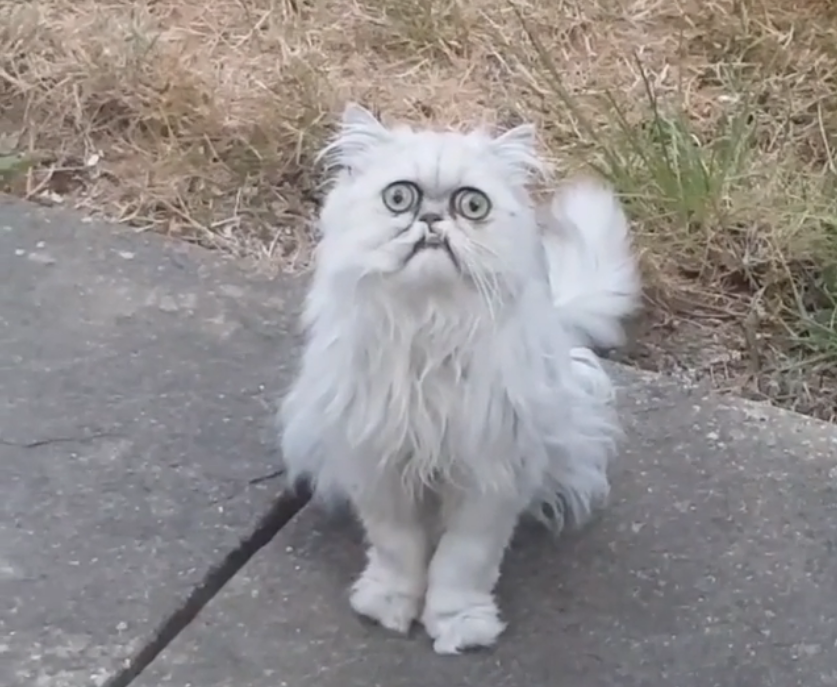
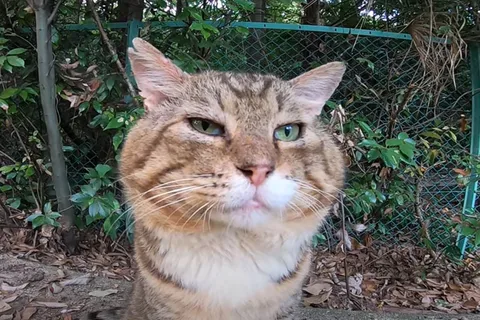
In the photo, the cat sits on a gray concrete slab next to dry grass. His fur is light, silvery-white, long and tangled, especially on the chest and head, where it sticks out to the sides. The most noticeable thing is the eyes: large, round, light-colored, looking up and slightly to the side. The flattened face with a small nose adds to the impression of confusion.
The front paws stand side by side, and the tail is visible on the right behind his back in a fluffy arc. The pose is relaxed, but the facial expression makes it look as if the cat has just noticed something unpleasant. This mismatch between the relaxed body and the dramatic face is what makes the frame recognizable.
How the cat became known
In autumn 2018, Western press and social media began calling the cat “scary” or “strange”: photos and videos of him spread across Reddit and other platforms, and in mid-November television news started reporting on him. Journalists compared him to Gritty, the shaggy mascot of the Philadelphia hockey team, who also became a meme subject in autumn 2018.
The exact date of the first publication and the number of times the video was reposted are not known. So it is safer to talk about a noticeable surge of interest in late 2018 rather than cite specific reach figures.
Breed, name and owners
According to the press, the cat's name is Wilfred Warrior, and his pedigree lists him as Fearless Warrior. The breed is Persian chinchilla. The cat has his own social media account, which had about 80,000 followers in 2018, and he reportedly lives in London. The owners' names are not given, and they are not needed to understand the joke.
Features of his appearance, such as the bite, the bulging eyes and the thick fur, are traits of the animal that prompt jokes, but they are not evidence of his well-being. The image is based on a real cat, not a fictional character.
Why the expression is funny
What makes it funny is the mismatch between expectation and expression. The cat looks as if he has been caught off guard, although there is nothing special around him: an ordinary street, grass, concrete. The viewer fills in the story and sees fright, bewilderment and offense all at once in his face.
The emotion visible in the picture does not prove the animal's inner state. The cat may simply be looking up at something outside the frame. The joke rests on the caption and context, while the face only provides the initial spark.
Caption examples
Four captions invented for this frame. All of them rely on the face already showing a strong reaction, while the text explains its cause.
“They said the report is needed today, and right now.” The caption sets up unexpected news, and the cat's expression becomes the reaction to it. The contrast between the flat phrasing and the panic on his face does the work.
“The restaurant bill turned out longer than the menu.” The joke rests on a sudden shift in expectation, and the cat's look fits a sudden discovery best.
“I just went out for a walk, and here you are with your advice.” Here the caption makes the cat an offended party in an argument. The comic effect comes from him looking indignant exactly as much as his face allows.
“The team chat said: let's skip the meetings. Meeting in five minutes.” A short line and an everyday scenario: viewers recognize themselves in the reaction, even if the reason is minor.
How to use the frame
The image works well for stories where a sudden reaction is needed: news, an unexpected bill, a sharp question. The simpler the situation, the stronger the contrast with the facial expression. It is better to give one line and leave the rest to the viewer than to try to explain the cat's fright in detail.
If a caption concerns a real person, it is better to avoid personal details: the joke should work on the situation. The animal is the main character of the frame, and his expression is what makes the text understandable. Do not mock the cat's appearance as a flaw: his unusualness is exactly what earns him sympathy in this story.