The ad where Alexios replaces Alexa
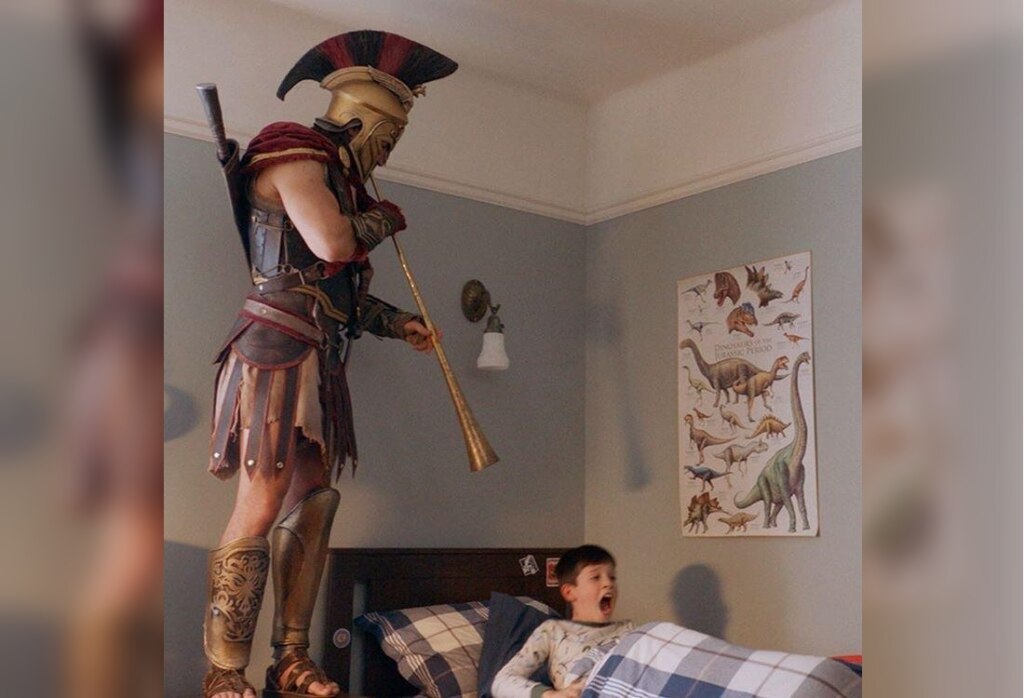
The image is based on the Ubisoft and R/GA campaign “Alexa Meets Alexios” for Assassin's Creed Odyssey. In it, the game's hero arrives in a modern home as a voice assistant: he can answer a question or report a forecast, but does so with martial force. In the scene by the bed he chooses the most direct way to wake a child: he brings a long horn to them and blows it.
This frame deliberately collides ancient military aesthetics with an ordinary bedroom. Armor and helmet sit alongside a blanket, a soft toy and a poster on the wall. This is neither a game scene nor a historical reconstruction, but an advertising fantasy about what Alexa would look like if she answered like an Assassin's Creed hero. The campaign came out in September 2018, before the game's general release on October 5.
The ad's Alexios also had a practical prototype: a voice skill for Amazon Alexa answered questions, reported the weather and helped with the calendar. The horn by the bed is a comic contrast to this digital function: instead of a gentle alarm signal, the person gets a military summons. So the same advertising promise in the frame is at once recognized as a modern assistant and turns into a completely out-of-place ancient alarm clock.
From ad scene to caption
A screenshot of exactly this moment spread separately from the clip. Early posts appeared on Reddit on the day the ad came out; within a couple of days captions were being added to the frame, distributing roles between the horn-blowing warrior and the sleepy child. The date of the ad should therefore be distinguished from the format's later growth: the video launched the image, and the captions turned it into a convenient scene for reinterpretation.
In the original frame the action explains itself: the horn replaces the alarm clock, and the warrior is a signal that cannot be tactful. In a caption you can change not the image but the meaning of each participant. The Spartan becomes an urgent task, a notification or a sudden obligation; the child becomes a person who wanted five more minutes of quiet.
Why a simple signal becomes an event
The frame does not show a long story of waking up. The climax has already been reached in it: the warrior stands by the bed and gives the loudest possible signal, while the child has opened their mouth wide. This difference in scale makes a sleepy morning look like a state of emergency. It's funny not only because of the costume in a modern room, but because of the disproportion between an ordinary task and the way it is carried out.
Because of this, the meme can be attached to recurring things that don't usually look heroic: a deadline, a call or a request to leave the house. When a caption names a specific irritant, the horn-blower's pose starts to sound like its loud command. And the child serves not as a portrait of a particular person but as a sign of the sudden resistance caused by getting up too early.
Invented captions
“I'm up at 6:30 on Saturday, an alarm for the run.” This invented caption gives the Spartan the role of a habit that has already beaten the desire to sleep in.
“When the courier writes ‘I'll be there in a minute’ and you're still in your pajamas.” This is also a made-up example: the horn turns a short notification into an alarm siren, and the child into a person who urgently needs to get ready.