The pose before movement begins
In three-dimensional graphics, the T-pose serves as one of the reference positions of a humanoid character. The arms point horizontally to the sides, and the body stands upright. This shape helps to set and align the positions of the model's parts before animation. The name literally describes the silhouette: the vertical torso and the horizontal line of the arms form the letter T. It is a professional technique that existed long before its internet popularity.
In games, a character sometimes freezes in a similar position because of an animation glitch, and the technical view unexpectedly appears within a finished world. Meme remakes turned this incongruity into a standalone joke. In 2016, variants with Hugh Neutron, a character from “The Adventures of Jimmy Neutron,” were circulating, and in 2017 a separate Reddit community, TposeMemes, appeared. By 2018, the format had moved beyond models: participants photographed themselves with outstretched arms and portrayed their own lives as a strangely functioning game.
Three motionless figures by a wall
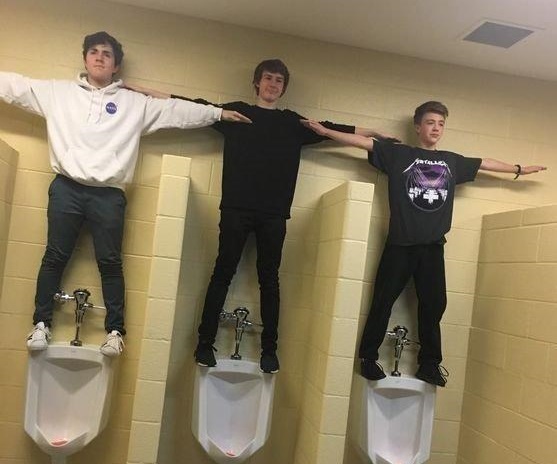
In the photograph, three young men stand at urinals in front of a yellow tiled wall. One wears a white hoodie, and the other two wear dark T-shirts. All of them have stretched their arms out to the sides, occupying almost the entire width of the frame. The wall, the fixtures, and the ceiling mark an ordinary room; there are no captions or game interface. The names of the participants, the place, and the date of this particular shot are unknown.
The composition links the figures into a repeating pattern. The people look as though they have all adopted one initial state at the same time, even though their clothes and faces differ. The unusual position above the floor adds absurdity to the frame: a familiar everyday setting has become the stage for an almost monumental group. They are not performing any visible action; they are presenting the pose itself to the viewer. Because of this, the photograph reads as a staged glitch in which stillness suddenly becomes the main event.
Power without a single movement
The ironic display of superiority arises from an excessively open silhouette. The hero takes up space but does nothing that is usually associated with strength or confidence. The outstretched arms seem to announce his greatness on their own. For a viewer familiar with games, this is especially funny: a pose meaning the absence of a finished animation is presented as the final and most impressive form of the character.
Human photographs have one more effect. The viewer sees a deliberate game of a non-working model: the participant is able to move but intentionally cancels natural gestures. A serious face intensifies this impression. The result is a small pantomime in which the absence of reaction becomes a reaction to everything at once. The T-pose can signal a solemn entrance, a freeze from surprise, or a refusal to take part in a normal conversation; the specific meaning emerges from the surrounding situation and the caption.
When the animation has not loaded yet
In an invented picture, a video call participant freezes with outstretched arms, and the caption reads: “My answer to the question of what I did over the weekend is still compiling.” The pose depicts a pause for thought as a technical delay. Another variant concerns a game: a new ruler of a fantasy kingdom adopts the T-pose, and all the courtiers decide it is an ancient ceremonial gesture. The glitch turns into a tradition, because those around attribute too much meaning to it.
A third imagined plot shows a cat that has been drawn with two horizontal front paws above the caption “Apartment owner mode loaded.” This is already a parody of the display of status itself: the hero does not become bigger or smarter, but claims full dominance with a single silhouette. What links the various examples is the recognizable starting position, which has moved from a service stage of creating a character to a deliberately absurd finished performance.