The scene in the photo
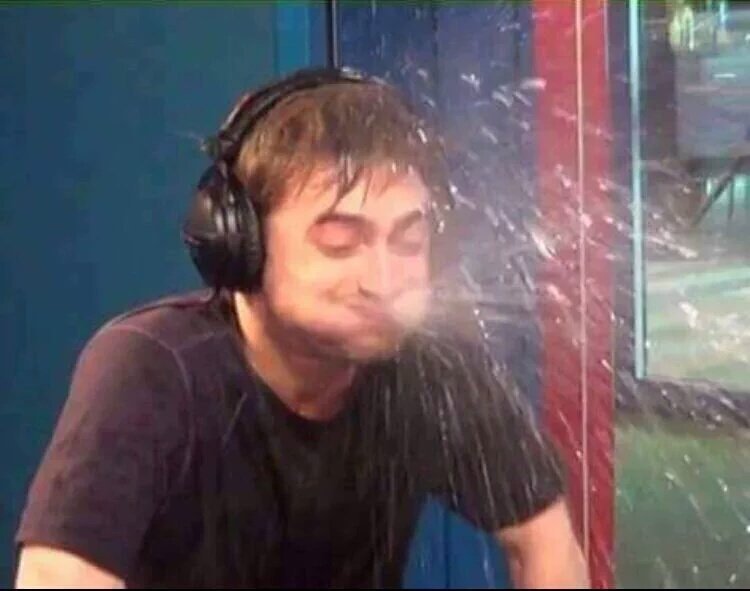
The photo shows a man in a dark T-shirt and large black headphones, sitting indoors with blue and red panels. His eyes are closed, his lips are pressed together, and small droplets of water fan out from his mouth, spreading toward the side and landing on his hair and clothes. A glazed opening is visible on the right. The frame was taken at the moment when something has already happened but has not yet ended.
It is this moment that makes the picture a meme. The water itself does not look like a joke: it is a capture of a reaction. That is why captions are built around the suddenness rather than the action itself. The meme’s subject is called Daniel Radcliffe, but the photo itself does not confirm the identity, so captions are better built around the situation rather than the person.
Possible origin
Frames of this kind are usually associated with the Innuendo Bingo game on Scott Mills’ radio show on the British station Radio 1. According to descriptions, participants were asked to hold water in their mouths while listening to a selection of phrases with double meanings, and whoever could not hold on sprayed the water out in a fountain. Various guests took part in this game, including well-known people, and they often ended the broadcast soaked.
There is no confirmation that this particular photo was taken in the studio of this show, and the exact date of the shoot and the author of the frame are unknown. The origin remains unestablished, and linking it to a specific episode is a hypothesis.
Why the reaction is funny
The meme rests on the contrast between expectation and result. Usually a person is ready for a calm conversation, but a sudden turn bursts out. The water fountain becomes the physical expression of words, laughter or surprise that could not be held in.
It is also important that there is no real harm in the photo. The scene is cheerful and a little absurd, so the frame suits light situations and does not fit serious ones. The reaction is strong because it is boisterous and harmless, which means it can be shown without awkwardness.
Caption examples
Four standalone examples. First: “The boss asked: ‘So, ready for the call?’ — five minutes before the call.” The example is built on contrast: the question sounds mundane, while the frame’s explosive reaction turns politeness into a small catastrophe.
Second: “When a message saying ‘let’s talk’ arrived in the chat without a single period.” The difference between a short text and what the reader managed to imagine is what makes it work.
Third: “The neighbor said today’s soup is an acquired taste.” The joke relies on a shift of expectation: the phrase “acquired taste” sounds like a recommendation, while the frame shows what a first impression of the dish looks like.
Fourth: “When the coffee turned out to be tea that was trying very hard to be coffee.” The reaction becomes an evaluation of an ordinary object. In every variant, the caption names the trigger and the picture shows the consequence.
Handling a recognizable face
The frame works well for instant surprise: a letter arriving at a bad moment, an unexpected bill, news nobody was waiting for. The caption should explain the trigger, otherwise the viewer will not understand what the person is reacting to. The shorter and more specific the phrase, the stronger the effect.
A photo of a well-known person is better not turned into a reason to mock his private life or biography. Captions work with the situation in the frame, not with the person behind it. The ambiguous jokes on which the original game is built are best not reproduced in public captions.