A family snapshot and its first frame
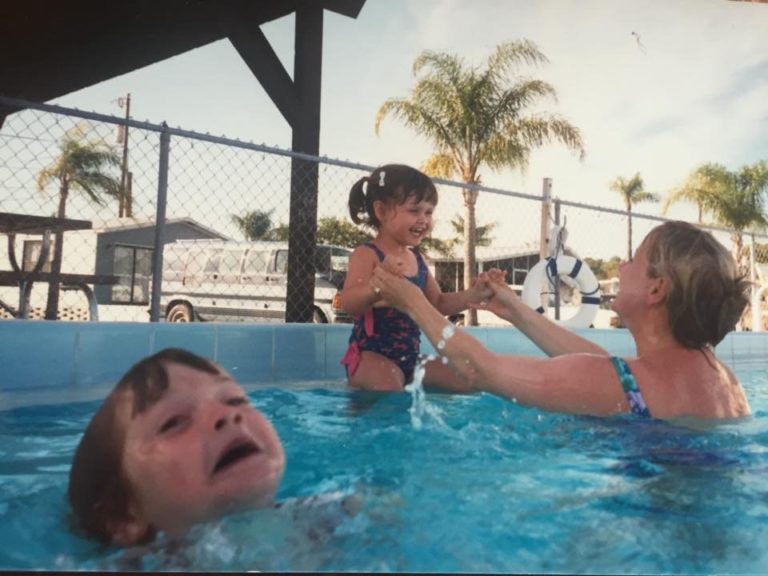
In April 2018, Reddit user ConnorBig posted a photo of relatives by a pool and captioned it as a picture of cousins learning to swim, taken around the 1980s. This description sets a calm family frame: children learning the water, an adult helping one of them. In May of that year an early version with object captions appeared, and the photo was later linked to situations where an important person or task goes unattended while everyone is busy with something more noticeable. The date the photo was published and the date the playful captioning appeared are different events.
What is seen and what the caption adds
In the photo, the boy is in the water with his head held above the surface; nearby, an adult woman supports the girl by the hands. The child’s smile and the adult’s closeness make the scene look calm on the surface. But the photograph freezes a single moment, so from it one cannot tell who actually needed help, how long the scene lasted, or what happened before and after the frame. The meme’s title exaggerates the risk, and the captions sometimes turn the child into a symbol of a problem nobody notices. It is the text that sets the anxious reading and turns an everyday snapshot into a dramatic scheme.
The composition of attention
The meme works through two planes: a bright moment of help in the center and the child in the foreground, who seems less noticeable. The captions distribute roles among “the urgent task,” “the familiar success,” and the person who chooses the second. The more specific the captions, the clearer the mismatch: attention goes not to the most important needs but to whatever is easier to praise or show off. That is why the format suits organizational and everyday situations where a conspicuous trifle crowds out a less spectacular but more important problem. Sometimes the author deliberately makes the “important” side absurdly small, so that the accusation of a wrong choice becomes satire on other people’s priorities. In other versions the captions are gentler and simply describe an imbalance of attention. The eye first notices the bright pair in the center, then returns to the figure in the foreground; this delay is what produces the effect of a belated discovery.
Invented captions
Invented caption: “The team congratulates on a beautiful presentation, while a critical error in the calculation stays in the spreadsheet.” The girl becomes the visible achievement, and the boy the problem still to be noticed. Another version: “Everyone is discussing the new website design while the payment form isn’t sending orders.” Here the picture speaks of prioritizing the outward look over a working function. Finally: “The family chat is arguing about the cake color, while grandma can’t open the video call.” In this case one participant gets the attention and another is left out of the conversation. These are invented situations; none describes the people in the original photograph. The invented captions change the topic but keep the same overall imbalance: the more noticeable wins over the more pressing.