What's happening in the frame
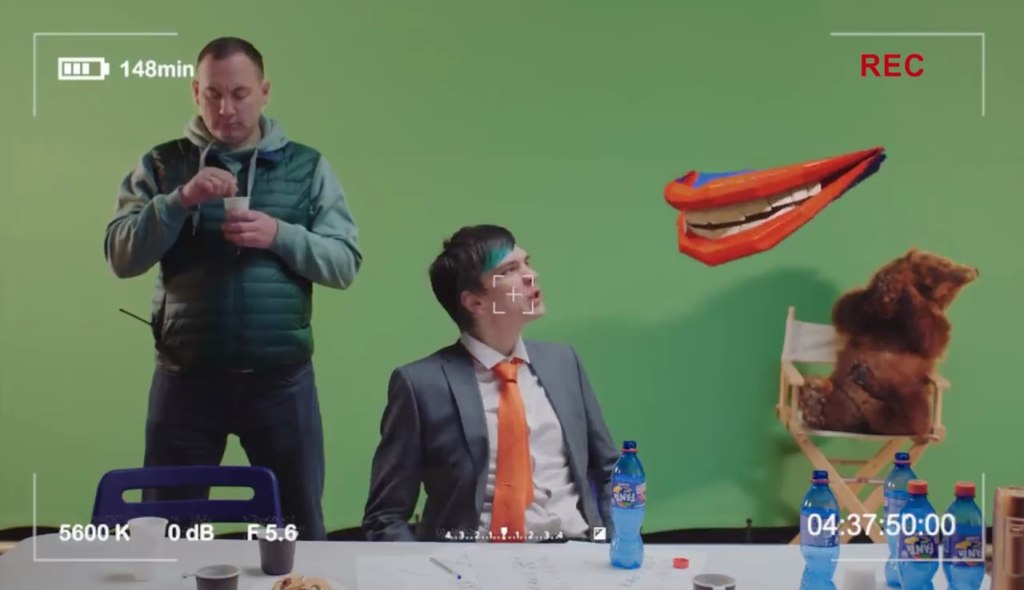
The image is styled as camera footage: a viewfinder frame runs along the edges, with a battery icon and “148min” at the top left, a red REC label on the right, settings 5600 K, 0 dB and F 5.6 at the bottom, and a timecode of 04:37:50:00 on the right. All of this creates the feeling of a glimpsed pause on a film set.
The background is a plain green wall of the kind used for inserting computer graphics. On the left stands a man in a green-gray vest holding a small cup; he looks down and does not interfere with what is happening. In the center sits a young man in a gray jacket, white shirt and orange tie, with short dark hair and a turquoise strand. He has tilted his head back and is looking at a large orange-red mouth with white teeth hanging in the air to the upper right. Next to him, on a director's chair, lies something fluffy and brown, like a toy bear. On the table there are blue Fanta bottles, papers and cups.
What is known about the origin
The only direct clue is the Fanta bottles on the table: the frame seems to be connected with an ad for this drink. Which exact video it is, who shot it and what year it came out is not reliably established, so confident claims about the flavour name or the release year are not given. What is known for certain is only what the picture shows: a person is talking to a flying mouth while the others are busy with their own things.
The phrase in the picture is apparently the main point of the meme. It is said not by the characters but by users who insert the picture as a reply in an argument.
Why the joke works
The meme is built on a literal image. An ordinary interlocutor has a face, a gaze and gestures; here nothing remains of the person but one mouth, and even that exists separately from a body. This is how an accusation of empty talk looks visually: lots of words, but no one behind them.
The second layer is the reaction of the person in the center. He is not angry and does not argue; he has tilted his head back with an air of weary patience. This makes the frame a handy reply for situations where there is no strength left to object but you would like to stay silent with dignity. The figure in the vest in the background adds a domestic note: an ordinary working day is going on around, and nobody is surprised that a mouth floats by itself.
Importantly, the meme is not about the specific person in the frame. It is a template for other people's words, so it is better aimed at a situation or at one's own behavior rather than at a real opponent for the sake of harassment.
If you make your own edit, keep in mind that the frame is already overloaded with details: the viewfinder border, the timecode, the bottles, the toy on the chair. So the caption should be short and placed in the clean green area, otherwise the reader will find it hard to know where to look.
Examples for your own caption
“A meeting an hour long. Decisions: zero” — the mouth personifies a speaker who talks about everything. The joke works on the contrast between duration and result.
“A friend explaining to me how I should have lived while I'm paying off his own debts” — a version with resentment: the man with his head tilted back plays the one being lectured.
“Me when I'm telling a story and have already forgotten where it was going” — self-irony: the flying mouth here is the caption's author.
“A nine-email newsletter to tell me the meeting has been moved by an hour” — the mouth as a stream of text from which you have to extract a single sentence.
How to use the template
The frame works best for replies and reactions where you need to show fatigue from chatter. A large caption fits well at the bottom or top of the green background: there are few details there, and the text covers neither the face nor the mouth.
If you want a self-deprecating version, caption the frame from the mouth's point of view. If you want a cutting one, caption it from the point of view of the person in the center. Do not attribute to the characters real lines from the ad: their content is unknown.