Osborn meets Parker
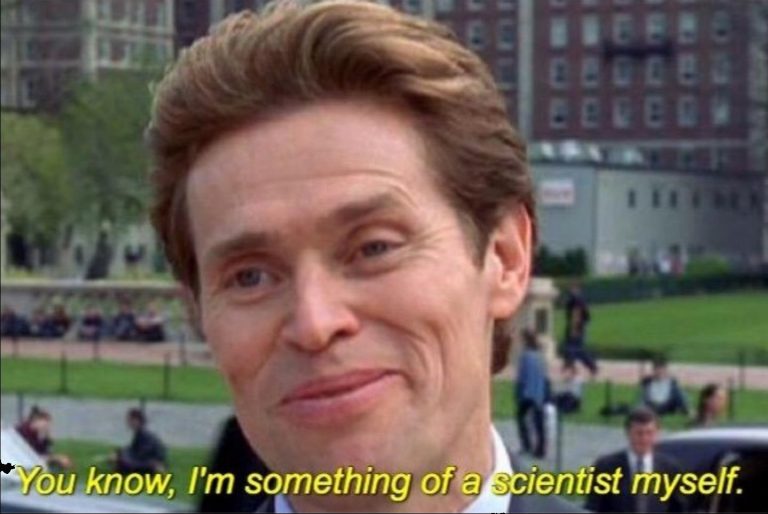
The frame is from Sam Raimi's Spider-Man, released in 2002. Norman Osborn is played by Willem Dafoe and Peter Parker by Tobey Maguire. When they meet, Osborn refers to Harry's stories about Peter's scientific abilities and remarks that he too works in science. Within the film this is a natural attempt to find common ground: Osborn is in fact tied to research and to the tech company Oscorp, rather than passing off a household success as a profession.
The internet changed the line's position in the conversation. An early well-known remake with this frame appeared on 4chan in October 2016: the dialogue continued as an absurd monologue from Osborn's perspective. In June 2017 Reddit already had macros where the quote served as a reply to the simplest technical achievement. In February 2018 the format spread widely across meme communities. It became part of Raimi-posting, the practice of playing with frames and lines from Raimi's trilogy.
A face without an interlocutor
The image shows Osborn in close-up: combed brown hair, slightly raised eyebrows, and a calm half-smile. Behind him are people, a green lawn, and buildings. Peter remains outside the frame. Along the bottom edge runs the yellow English line “You know, I'm something of a scientist myself.” The composition already resembles a finished reaction: a person confidently announces himself, and his interlocutor is replaced by the reader and the situation described in the added caption.
The scale of the discovery and the scale of self-esteem
A typical joke connects a small result with a big role. The person pressed the right button, noticed a simple pattern, or recalled one school term, and immediately gets a researcher's face. The line is especially funny because the wording is cautious: “something of a” seems to lower the claim. In practice this modesty only highlights how solemnly the character rated his trivial success.
The self-ironic version gives the hero the right to briefly enjoy his luck. A more biting one targets someone's loud claim after minimal acquaintance with the subject. The upper caption sets the difference: “I figured it out” invites laughter together with the author, while “expert after one video” makes the overconfidence the target of mockery. The scientific quote can also work outside the lab: in home repairs, cooking, game settings, or organizing domestic life.
Three discoveries of the home institute
In a fictional scene, a person finds that a desk lamp turns on after being plugged into an outlet. The upper caption announces the successful fix of a “complex electrical fault,” and Osborn welcomes him into the ranks of scientists. It mocks the delight in finding something obvious, familiar to anyone who has spent too long searching for an elaborate cause of a simple problem.
Another fictional example: a player moves chests twice and notices that sorting items by color is less convenient than sorting them by purpose. A scientific line follows. The useful observation remains useful, but the solemn presentation turns rearranging virtual boxes into research of world significance.
The third fictional story is culinary. The author places three identical mugs side by side so as not to pour the drink into containers of unknown volume, and announces that he has developed a portion control system. Dafoe closes the report on the home experiment. In all three cases the caption states a concrete small success, and Osborn's face sharply raises its symbolic status.
The line as material for rearrangement
A separate branch of remakes changes the bottom line itself: words are covered, shortened, or rearranged. The joke then rests on a new statement, which the viewer mentally compares with the familiar quote. The close-up keeps it recognizable even when the science theme disappears. This kind of play is aimed at an audience that remembers the original rhythm of the line and notices how little text had to change to produce a completely different meaning.