Scene from the trailer
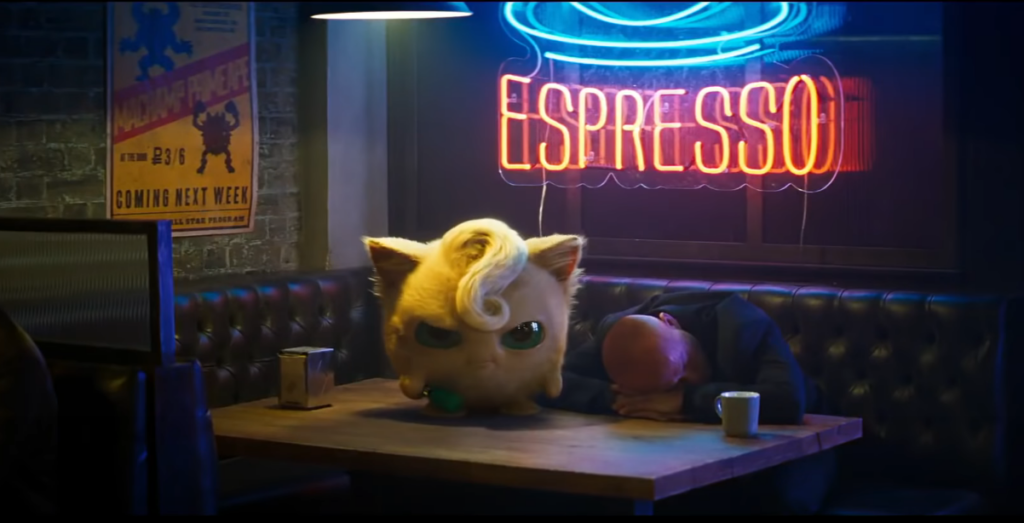
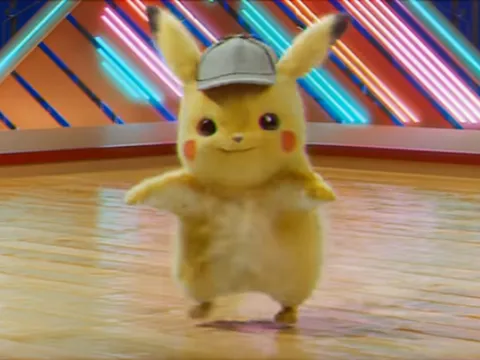
The frame is taken from the first trailer for the live-action film based on Pokémon; the film itself hit theaters in May 2019. Jigglypuff is rendered here in 3D graphics: fluffy, light yellow, with large green eyes and a curl on top of its head. It sits on a table in a café and looks at the viewer, brows furrowed, mouth pressed shut.
The background matters: on the left, a yellow poster hangs on a brick wall, and on the right, a neon sign reads ESPRESSO. At the same table, on a couch, a man in dark clothing lies with his head down on his arms, a cup in front of him. He is what makes the scene funny: the Pokémon is awake and clearly displeased that its audience has fallen asleep.
Where the song and the sleep come from
In the games, Jigglypuff's move is called Sing: it puts the target to sleep. In the anime, this Pokémon became the hero of recurring storylines: it sings, the listeners fall asleep, it gets offended and reaches for a marker. So a viewer familiar with Pokémon sees in the frame not just a café and a sleeping person, but a familiar situation: “it sang, and the audience is asleep.”
Those who are not familiar with Pokémon also understand the scene without explanation: a sleeping person, a puffed-up plush character and a feeling of hurt are read at once. Because of this, the template has spread beyond the fan circle.
How the frame spread
Warner Bros. published the trailer on November 12, 2018, and viewers quickly noticed the frame with Jigglypuff: it became a reaction to injustice, hurt feelings and fatigue with an indifferent audience. The author of the first screenshot and the earliest signed version are not known for certain, so it is not possible to point to a “first post.”
The jokes were built around one idea: a cute round character suddenly shows its temper. The familiar picture of “sang, and everyone fell asleep” easily carries over to presentations, voice messages and any long story.
Caption examples and why they work
“When you sang and everyone fell asleep.” The caption repeats the logic of the scene: the Pokémon is offended by the audience, and the joke carries this over to any failure.
“The presentation is over, but the sleepy colleague is still on the attendee list.” This example moves the frame into an office. The angry face becomes a reaction to indifference toward a report, and that is where the comedy comes from.
“Sent a six-minute voice message and got back one emoji.” The effect rests on exaggeration: the expectation of an emotional response collides with a tiny reaction, and Jigglypuff's little face expresses disappointment on the sender's behalf.
“My plan was perfect, until he showed up.” Here the roles flip: the irritated character turns out to be the one who was waiting for attention, and the sleeper becomes the obstacle. The joke depends on the shift in point of view, not on the anger itself.
How to use the template
The frame works best for small disappointments, where the emotion is big and the reason is small. The contrast between a round, cute character and its anger works on its own, without a long caption.
The scene should not be captioned as if the sleeping person is the object of mockery. It is funnier when the victim seems to be the Pokémon itself. Then the meaning stays in the reaction rather than in a real person, and the joke reads as good-natured.