Six years become two cells
In March 2018, fan comparisons of Miley Cyrus's public photos appeared on Twitter alongside user posts under the hashtag #2012vs2018. People placed an old and a new picture side by side to show a change of hairstyle, clothing, age or their own attitude toward the camera. A long stretch of time was folded into a pair of images that could be understood in a few seconds.
Participants quickly expanded the plot beyond appearance. Two frames could tell a story about studying, work, a hobby or accumulated belongings. Other remakes depicted an almost complete absence of change. Parodic posts were already noticeable in the same March wave: the comparison was used both by individuals and by organizational accounts. The form of a personal memory turned out to be convenient for a joke about anything that can be imagined as a past and a present.
The pair remains at the center of the collage
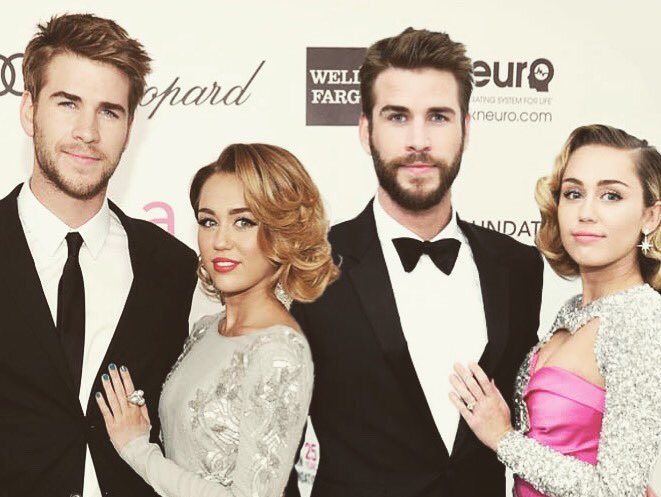
The image combines two joint photos of Liam Hemsworth and Miley Cyrus. On the left he wears a dark jacket and tie, she wears a light shimmering outfit. On the right he has a fuller beard and a bow tie, and she wears a pink dress and silver outerwear. In both cases Cyrus holds her hand near Hemsworth's chest, so the similar pose helps to line up the different images.
The collage itself does not print the years. Its juxtaposition with the title of the flash mob does not establish the dates of the two specific shoots. The visual task is clear even without such precision: the same people, a similar distance between them and noticeably different details of clothing. The repeated composition makes the changes easy to see, and the pair itself serves as a constant point of comparison.
The distance between the frames is filled in by the viewer
A comparison meme has no intermediate chapters. From two poses or objects, the viewer mentally assembles a whole story: a person has mastered a new pursuit, changed their style or kept an old habit. This economy of means is especially handy for contrast. A small thing on the left and a huge one on the right create a story of growth; identical pictures turn the promise of progress into comic treading water.
The format does not, however, require an improvement. A more solemn new image may be a serious outcome, or it may parody the expectation that everything must become impressive over six years. Sometimes the second frame is deliberately absurd and breaks the story of maturing. The effect arises from the relationship between the halves: one and the same photo acquires a different meaning depending on what it is placed next to.
Three small stories about time
An invented example with music would begin with a photo of a first clumsy attempt at the guitar and end with a picture of a performance in a small hall. The repetition of the instrument matters: the viewer recognizes the activity, while the change of setting tells of accumulated experience. Such a variant keeps the sincere mood of a personal flash mob, even if the first attempt looked funny.
Another collage would show one pot with a small sprout and a room almost filled with grown-up plants. Here it is not the owner's face that changes but the scale of his hobby. The caption about six years explains how a modest purchase could turn into a home jungle, and at the same time exaggerates the power of the new hobby over the space.
A third scene would place two pictures of a cat in one and the same favorite box side by side. In that time the owner changed jobs, apartments and clothes, but the cat's choice looks unshakable. The repetition refutes the solemn theme of change. The format gets its joke precisely because the viewer is first offered a large span of time and then shown a surprisingly steady little detail.