What's shown
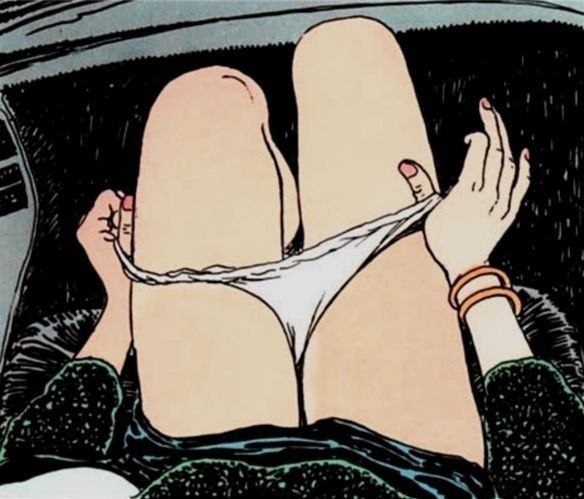
The illustration, done in contrasty ink hatching, shows the inside of a car. A close-up shows a woman's bare legs, with one hand pulling down the edge of her underwear. The shot is cropped above the hips and doesn't show her face, leaving the character depersonalized and reduced to a body and a gesture.
The drawing's style, dense hatching, sharp outlines, and color accents, nods to a comic-book and illustrative tradition. The image itself was conceived from the start as an explicit scene, which is why the meme is discussed as an example of sexualized humor rather than an everyday picture. The contrasty hatching makes the shot harsh and heavy, which is exactly why the joke lands as unpleasant rather than simply funny.
Origin
The source of the illustration and its author haven't been established. Stylistically the drawing resembles a fragment from adult comics, though this hasn't been confirmed. The exact date the meme appeared and its first post are likewise unknown, so its origin can only be discussed as a guess.
Like many pieces of internet folklore, this illustration entered circulation through imageboards and themed communities. It was cut out of its original context, fitted with captions, and spread as a standalone template. The catalog dates the meme to 2014, which matches the period of its greatest activity in the Russian-speaking internet.
How it's used
The meme is used as an ironic reaction to claims that sound too good to be true. The question "Are you sure?" makes the other person doubt their own words, while the picture adds an inappropriately explicit contrast. The caption works as mockery of the statement itself. For example, in response to a loud boast in a discussion, when someone describes implausible earnings, the caption instantly casts doubt on the whole story.
A second line of use is a caption that ties the image to a crude stereotype about the popularity of certain professions or about the availability of women. This kind of humor leans on sexist assumptions, and it's often criticized in discussions. This aspect is key to understanding the meme: the joke isn't built on a plot but on devaluing a woman as an object. That's why, in discussions about memes, it's often compared to other templates where a character is depersonalized, with people asking who exactly finds such humor funny.
Why the meme works
The comic effect rests on surprise and contrast: an explicit picture is paired with an ironic question, forcing the viewer to switch between two meanings. The sharper the switch, the stronger the reaction, which is why the meme gets laughs from those who see this kind of humor as a provocation. It also matters that the viewer sees the picture first and only afterward realizes that the caption turns it into a jab at the other person, and it's exactly that turn that sets the tone for the whole joke.
The meme also rests on the template's recognizability. One shot is enough to convey the whole implication, and the caption can change without losing its meaning. Debates about whether this kind of humor is acceptable never really die down around it, and in discussions the meme is often treated as an example of how internet culture reproduces sexist imagery.