How the shot came about
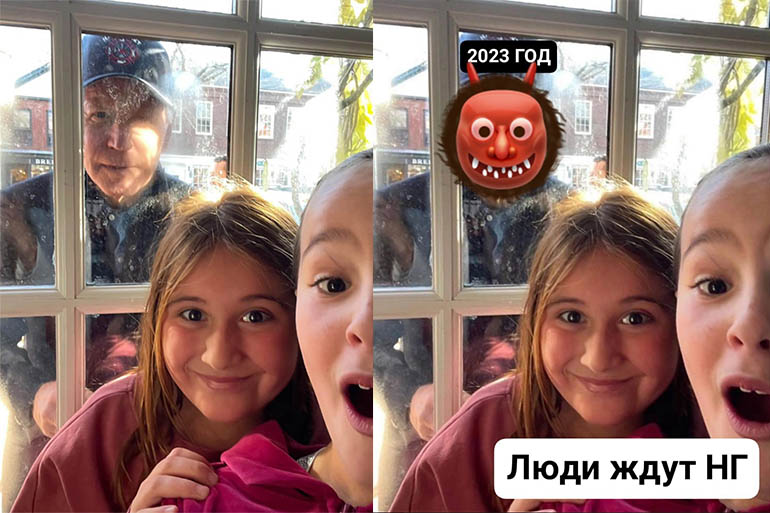
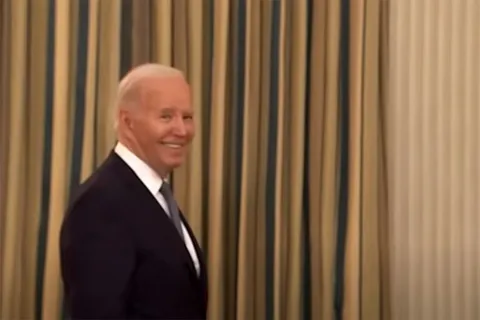
The photo was taken during Joe Biden's trip to Nantucket Island in Massachusetts for Thanksgiving 2022. The children were inside the Lemon Press restaurant when the president was walking down the street; he came up to the window, greeted them, and posed for a selfie. A local outlet published the photos and video on November 26. So the shot arose from a chance, friendly encounter, not from a staged attempt to startle children.
In meme crops, attention shifted from the encounter itself to the composition: two girls are inside the building, with a smiling Biden visible through the glass behind them. The perspective gives the scene the look of an unexpected appearance. It's the framing — not the episode itself — that turned a friendly meeting into a shot with a surprise-cameo effect, and that distinction is worth keeping rather than passing off the internet interpretation as proof of strange or alarming behavior by the president.
Why the photo became a template
The glass window works as a boundary between a familiar space and an unexpected visitor. The girls pose calmly while Biden's face suddenly appears in the background. The viewer reads the scene quickly, even without knowing the political context. A caption can turn the figure into a friend, a coworker, a delivery person, or a thought someone is trying to shake off. The combination of a harmless photo and an absurdly well-timed moment makes it handy for quick jokes.
The format carries different moods. Some captions play up the suddenness, others play up the idea that the right person showed up just in time for a group photo. The original shot is warm and contains no threat; adding accusations or hints of stalking to it is already a separate and potentially offensive interpretation. It's better to build jokes on the surprise-cameo effect rather than on the real children or their private lives.
From encounter to photoshops
After publication, the pictures began spreading on social media, and users started transplanting Biden into other photos or changing the captions. An edit could turn him into a mysterious onlooker, a party guest, or someone who overheard a familiar word. The viral spread came not from an unusual political statement but from a lucky moment caught on camera. Later versions belong to their editors; the original photo and the derivative memes should be kept distinct.
The popular theme recalls the classic mechanics of photobombing: a person unexpectedly ends up in someone else's photo. Unlike a staged photobomb, the initial encounter was real, but friendly and initiated by the children, who called out to the president. There's no need to pin down the exact first edit to understand the format, and it's hard to attribute it reliably. So one shouldn't claim that one particular edit was the sole source of all the jokes.
Examples of good-natured captions
"I told my coworkers I'd bring cookies, and now I'm already standing by the meeting room" — a caption for an office photobomb. "When friends are discussing a show you just finished watching" fits a chat if that one familiar face shows up in the background. For a family photo you could add: "Mom heard everyone was about to take a picture and made it in just in time." All these versions rely only on the unexpected appearance.
You could drop the figure into a party scene with the caption "I heard the word 'cake' from another room." In a gaming community: "When the team calls you in for a match and you only promised to pop in for a second." Don't present the children as objects of ridicule, and don't attribute invented words to them. If the image travels beyond a local chat, a brief caption like "a photo from a friendly encounter on Nantucket" helps preserve context and avoids a misleading implication.
Keep the facial expression and the appearance effect in the new version while changing only the situation. That way the reader understands it's the composition that's funny, not the encounter with the children itself. For a more neutral audience you could drop Biden's name entirely and describe the figure as a sudden guest in the background. The public figure is recognizable, but an accurate account of the shot's origin supports a respectful reading of the image.