What is shown on the cover
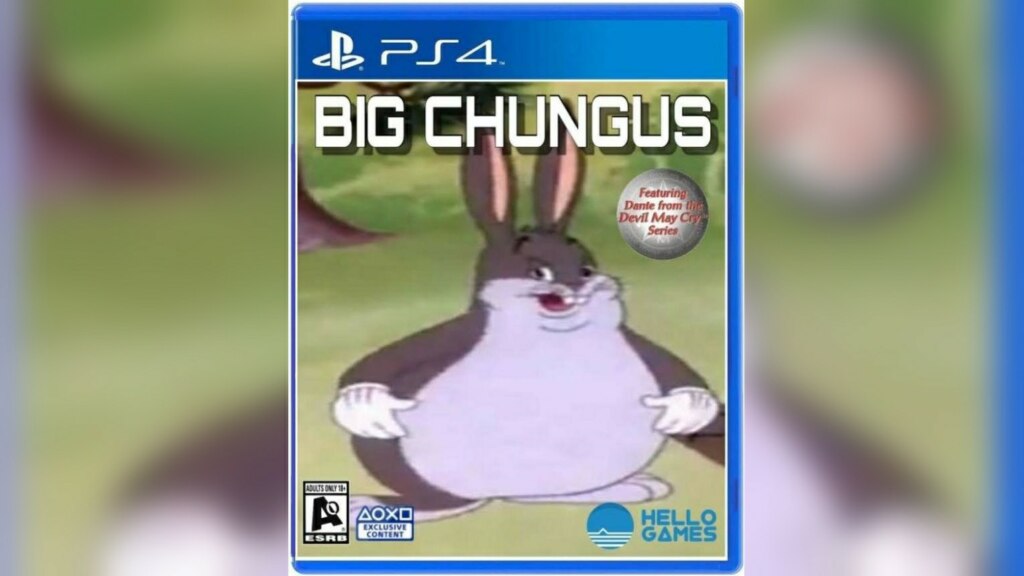
The picture shows a rabbit with gray ears and pink insides, wearing white gloves, with a sly smile and a huge light-colored belly. He is drawn in the style of old cartoons against a green background with a tree. A PS4 logo strip runs across the top, and the large words BIG CHUNGUS sit in the middle.
To the right of the rabbit is a silver round badge with the text “Featuring Dante from the Devil May Cry Series.” At the bottom left is a rating label in the style of console games and an exclusive-content badge; on the right is a Hello Games emblem. It looks like the cover of a real game, but no such game exists: it is a fake joke.
Where the word “chungus” came from
The word appeared online long before the rabbit. The earliest known case is often cited as a tweet from 29 June 2010 that read “there is a chungus among us,” but it went almost unnoticed and, as far as can be told, has no connection to the later story.
The word became a lasting joke thanks to the gaming podcast Podtoid: in 2012 a host told a story about “Chicken Chungus” and kept using the word for years afterwards. In 2013 a fan edited a video that laid the podcast audio over film footage, and in 2018 that video spread on Facebook. That is when “chungus” became a recognisable meme, and it was then attached to the round Bugs Bunny.
The rabbit from the classics
The full version of Bugs Bunny first appeared in the 1941 short “Wabbit Twouble”. The character belongs to Warner Bros., and the meme rests on his recognisable look: a nimble hero suddenly appears heavy and self-satisfied, and the contrast reads instantly.
Later the rights holder itself picked up this image: in April 2021, an event in the mobile game Looney Tunes: World of Mayhem officially named the character Big Chungus.
The fake box and the GameStop story
The PS4 cover was made by a Reddit user with the username GaryTheTaco. It is a pure joke: the box looks real, but such a game could never have been sold.
In December 2018 a post by a GameStop shop manager spread on social media. According to his account, a customer came in asking for the game Big Chungus and was very surprised that it was not on sale. The story has been retold in the press, but its details are hard to verify independently, so it should be treated as a popular retelling rather than a proven fact.
The line about Dante from the Devil May Cry series and the Hello Games logo are part of the general parody of game covers. The author did not explain why these particular elements were chosen, so it is not worth building complex theories around them.
Captions and how they work
“Asked for a small portion and they brought Chungus.” The contrast between the word “small” and the enormous rabbit creates the humor: expectation and result part ways on size.
“Waiting for a patch for a game that doesn’t exist.” The joke rests on an expectation that will never be met. The fake box makes the caption understandable without further explanation.
“Finally the DLC: Big Chungus, now even bigger.” The word “bigger” refers both to size and to content, and the double meaning keeps the caption short and precise.
“When the shop asked which game to pick for a child.” The caption turns the fake into a real purchase. The viewer recognises the 2018 story, and the absurdity of the choice becomes the main source of the joke.
How to use this image
The frame works well when you want to play on something big, clumsy or non-existent. If the subject is computer games, remember that the box is fake and do not present it as an announcement.
The caption should rely on the image itself: the plump rabbit and the PS4 cover. Complicated references are not needed, because the picture already explains the joke. Short lines about sizes, portions, workload and expectations work best, where the word “big” takes on an unexpected meaning.