A frame with two men
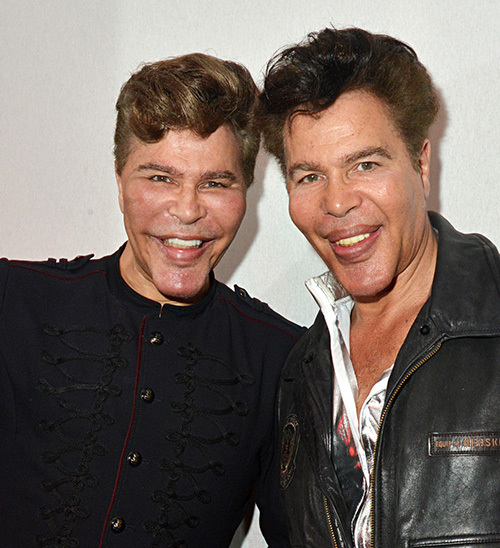
The photo shows two men standing close together against a light background, smiling broadly. On the left is a man with smoothly combed light-chestnut hair in a dark formal jacket with woven cord trim and a row of buttons. On the right is a man with a full dark hairstyle in a black leather jacket over a light, shiny shirt; the jacket has a small patch and a chest badge with lettering.
The shot resembles a photo from an event: a neutral background, open poses, looking at the camera. There is no caption in the frame. The meme's name points to the Bogdanoff brothers, but the photograph itself does not prove who is depicted, so the names here are taken from the meme's title, not from appearance.
Who these people are
Igor and Grichka Bogdanoff are French identical twin brothers who became known in the late 1970s as presenters of the science-fiction program 'Temps X.' The show, in which the hosts appeared in silver suits against the backdrop of a spaceship set, ran until 1987 and made them faces of French television. Later, reportedly, they hosted two more programs in the late 2000s.
The brothers defended doctoral theses: Grichka in mathematics in 1999, Igor in physics in 2002. The grade for their work was the lowest acceptable, and the scientific community was largely skeptical of their conclusions about the state of the universe before the Big Bang; later the brothers sued a number of scientists and publications. Grichka died on December 28, 2021, Igor on January 3, 2022; both were 72. According to the family's lawyer, the cause was COVID-19.
How the image became a meme
The brothers' appearance changed considerably over time, and the public linked this to cosmetic procedures; the brothers themselves denied it and spoke of certain 'technologies.' The photos began to be used in internet jokes, and the image detached from television: it became a sign of 'strange celebrity looks.'
A separate strand of jokes emerged in the crypto community from around the mid-2010s. In interviews the brothers claimed to have been involved in creating Bitcoin, and the internet came up with the image of 'puppet masters' who supposedly control the market and crash the price. The brothers themselves, reportedly, took it with humor.
It is useful to distinguish public discussion of television and science from mockery of a person's face: the first rests on facts, the second adds no meaning for anyone. Jokes about the market and the TV format do not create this discomfort.
Captions that do not mock appearance
'Evening episode about the Universe: first a riddle, then a confident voice-over.' This example transfers the style of a popular-science show to an everyday situation. The humor lies in the gap between the dramatic presentation and the viewer's actual level of knowledge.
'Scientists argue about what was before the Big Bang, and the TV has already announced the finale.' The joke relies on the well-known debate about the early universe, which the brothers' own work touched on. A serious topic is presented as a sensation, and that works as a device.
'Physics exam: please answer as on the old show, with a pause and a look into the camera.' The example shows how a television ritual becomes a meme frame for any complex topic. The pause and the look into the camera are read as a recognizable gesture.
How to treat this kind of meme
If you use this template, it is better to keep the caption about the show, the topic or the presentation style, not about the face. That is fairer to the people in the photo and makes a stronger joke: the viewer recognizes the show's format rather than judging appearance.
The topic of plastic surgery remains public, but decisions about one's own body belong to the people themselves, and the brothers are no longer alive. What matters more is the frame's meaning as part of the history of internet images, rather than amplifying mockery of appearance.