What's shown
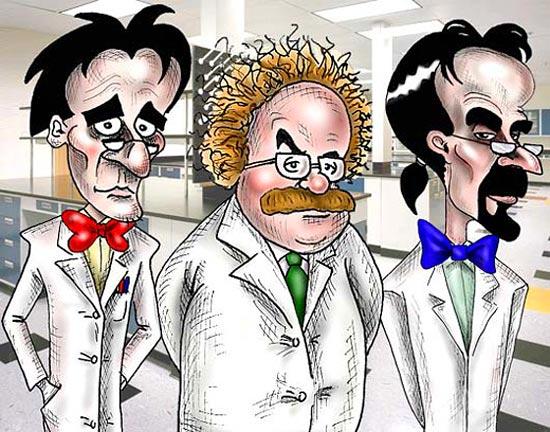
The illustration that became the meme's visual anchor shows three men in white coats in a laboratory: shelves of boxes and long tables recede into the depth of the frame. All three characters are drawn in a grotesque, caricature style. On the left stands a man with black hair combed back, a red bow tie, and a thoughtful, somewhat tired expression. In the center is a figure with a bushy reddish mane of hair, glasses, a thick mustache, and a green tie. On the right stands a bearded character with a blue bow tie and a sly look.
None of these figures is labeled or linked to any specific real person. The image works as a generalized symbol of "the scientist" as such: a set of recognizable markers, lab coats, glasses, exotic ties, and exaggerated seriousness, reads instantly and needs no explanation.
History and origin
The exact date the phrase "British scientists" appeared on the Russian internet is unknown, but researchers and journalists usually tie its rise to 2003 and a Russian-language blog on the site Dirty. More than a hundred posts on similar topics appeared there and quickly went viral. That's when the recognizable formula took shape: a report about a strange or outright absurd discovery would begin with the claim that it had been "proven by British scientists."
The specific author of the caricature and of the first post that used it couldn't be established, so the picture's origin can only be discussed in general terms. The British version took hold partly because the United Kingdom is associated with a strong academic tradition: Oxford and Cambridge are there, and the country produces a significant share of the world's scientific publications.
How it's used
In typical use, the meme serves as an ironic framing device for news. Phrases like "British scientists have found that cats understand their owner's speech" or "British scientists have proven that Monday is the worst day of the week" immediately signal to the reader that the report should be taken with a grain of salt. In comments, the phrase serves as shorthand for dubious, sensationalized science.
The meme also works without being tied to the country. If you swap "British" for "Japanese" or "Finnish," the joke keeps its meaning but loses recognizability: the nationality here became an arbitrary label, while the whole construction rests on a familiar cliché about how science news gets packaged.
Why the meme works
The joke's mechanism works on two levels. On one hand, it mocks the genre of "science" news in which a flashy headline matters more than the substance. On the other, it points to a real problem: according to available data, researchers at Cardiff University found that reporting on scientific papers is sometimes distorted as early as the press offices of universities, which occasionally hire staff with no scientific background.
Another reason has to do with the funding system. Grants often depend on how much attention the research attracts, so scientists end up having to actively publicize their work, while journalists simplify it down to a catchy headline. This contradiction is where the main source of the irony lies: the meme simultaneously mocks how science gets presented and how scientists themselves sometimes present it.
Not about any particular science
The meme doesn't question British science as such. It's not aimed at specific laboratories, but at an entire type of news coverage in which a scientific result turns into a headline of the form "scientists have found that..." That's why the humor is equally clear to people who know the inner workings of science well and to those who are simply tired of pointless sensations in their feed.
The meme stays relevant because a lot of new "studies" keep appearing, and no one is going to fact-check every one of them. The phrase has become a short formula for skepticism: it's enough to write "British scientists have proven" to signal, without further words, that a dubious discovery is being discussed.