A video game where choices change the story
Detroit: Become Human is a game by Quantic Dream, released in 2018. It tells the story of three androids in a futuristic Detroit and branches depending on the player's actions: choices affect the characters' fates and which scenes become available. Connor is one of the central characters, a police android investigating crimes. His storyline constantly forces him to balance the assignment, his own conclusions, and how to treat the humans and androids around him.
Against this background an interface with two blunt options reads as a tragedy compressed into buttons. In the game, such a fork relates to a specific dangerous situation, not to a universal way of solving real problems. The meme moves the familiar screen from a fictional plot into everyday life: it takes its dramatic tone and leaves the viewer free to substitute their own ridiculous dilemma.
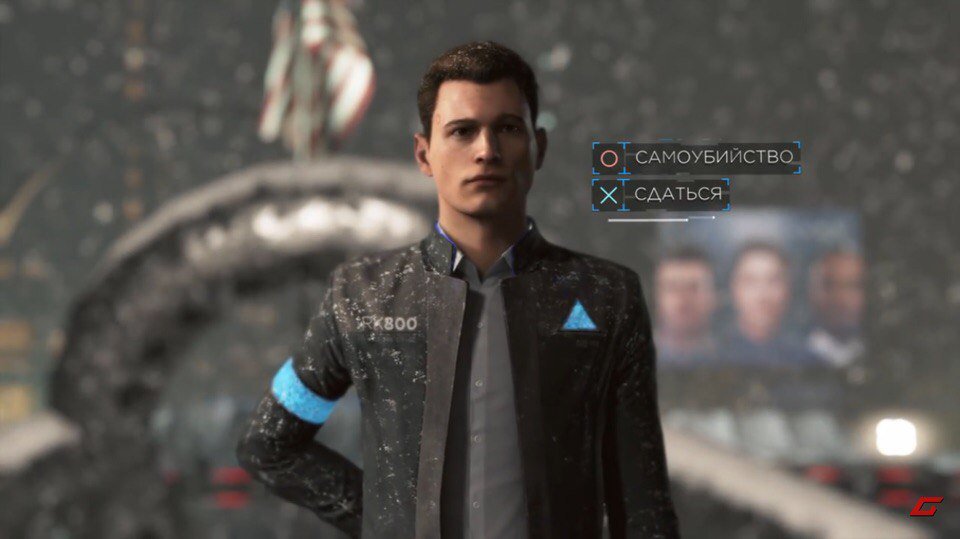
Connor and two buttons on the screen
Connor stands almost in the center and looks ahead. To the right of his shoulder are two highlighted lines with a circle and a cross — the controller's choice symbols. The upper line offers “suicide,” the lower one “surrender.” Blurred figures are visible in the background; they do not distract from the clean interface, which turns a complex decision into a simple fork: “button or button.”
Connor's face here is almost motionless, so the comic effect comes first of all from the on-screen words and the familiar game convention: the story has stopped while the player chooses. When the frame is transplanted, the captions are often replaced with options that are in fact incomparable in gravity. The contrast works better when the viewer immediately grasps the stakes of an everyday situation, rather than taking the caption for a real fragment of the game.
From catastrophe to a funny fork
The template turns a bad day into a scene of the final choice: two options stand on the screen one under the other, like the captions beside Connor. A person missed a bus, and in place of the game's two buttons there are two everyday lines: “run across the whole neighborhood” and “wait for the next one and explain to the boss.” This is an invented example, not an in-game line. The joke is not that the options are literally equal: one is simply unpleasant, while the second seems even worse because of the consequences the hero dramatizes.
Another invented variant: two invitations to the same meeting arrived at once, one from colleagues and one from relatives, and the same two lines pop up on screen: “cancel plans and confess” / “pretend the calendar broke.” The absurd substitution keeps the rhythm of the interface but moves the choice from a fantastic threat to an awkward social situation. The more mundane the problem, the more noticeable the gap between Connor's calm face and the categorical menu.
When the game speaks the language of menus
In an ordinary game, text on the screen serves as an instruction to the player. In the meme the same line starts to sound like the dry voice of fate: instead of a long explanation, the person is shown two buttons captioned something like “agree to an extra task” and “explain why I won't get to it today.” The invented example does not claim that in reality there are always only these two ways out; it depicts the feeling of being cornered by a menu.
The circle and cross symbols remind us that this is not an ordinary caption over a portrait but a frozen scene of choice: the player must press one of two buttons before the story can continue. That is why a short pair of verbs can replace a long description of inner conflict. In the everyday remake the form of the menu remains serious, while the cost of the decision drops sharply — and Connor seems forced to decide which of two kinds of awkwardness to endure today.