A live show before the game's release
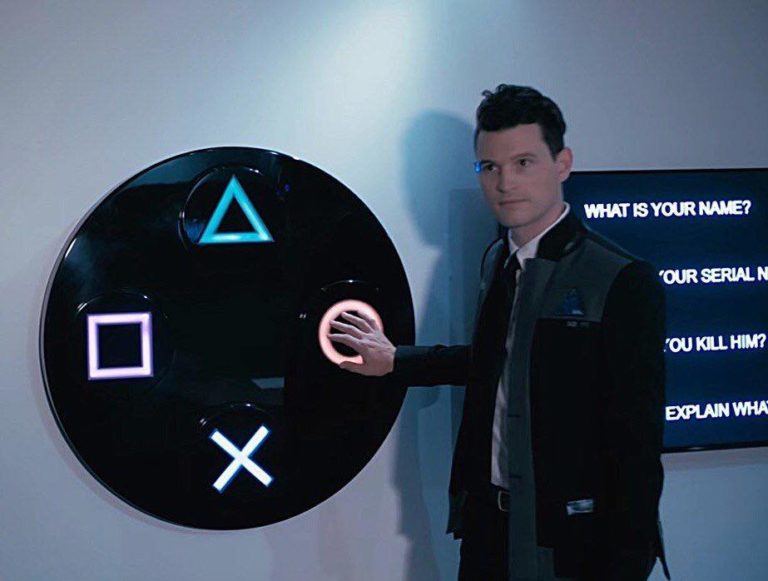
The photo is connected to a promotional interactive performance held on May 21, 2018, in Detroit. Quantic Dream worked with the theater company Les Enfants Terribles; the event took place at the Trumbull and Porter hotel. Audience members took part in the story of the android Eve, caught committing murder, and detective Nate. They were offered decisions on which the continuation of the scene depended. This was a staged show with live actors, not an episode filmed inside the game world.
Dechart appeared in the role of Connor as host and assistant to the audience: after a group decision, he pressed the required button on a wall panel. Detroit: Become Human came out on PlayStation 4 on May 25, so the show preceded the release by a few days. Photos of the actor were discussed in June, and in the second half of the month macros with new captions appeared. Among the early Russian-language traces, a post by MDK on June 23 is noted. The author of the very first meme choice has not been established.
Four symbols on one wall
On the left is a large round black panel: at the top a blue triangle glows, on the left a square, at the bottom a cross, and on the right a pinkish circle. Dechart stands on the right in dark clothes with a tie and touches the circle with his hand. Behind him a screen with several English questions is visible. The setting resembles a demonstration stand, not a police office interior from the game.
The panel is much larger than a regular controller, so the press cannot be missed. The actor's gaze is directed to the side, and his face keeps a serious expression. He seems to be carrying out a decision already made, without arguing with it. The square, triangle, and cross remain visible: the viewer sees not only the chosen option but also the three alternatives that the hero for some reason did not take.
Choosing seriously and picking the strange
The captions usually distribute four actions across the button symbols. Three of them may stand for sensible decisions, while the circle is a tempting, pointless, or inconvenient option. The hand turns the last label into the result: the author does not have to separately write “I chose this.” Connor's seriousness heightens the contrast, because the absurd option is accepted with the same composure as an important decision in an interactive story.
The game connection adds another layer. Detroit is built on consequences and forks in the road, while the meme ends all deliberation in a familiar habit of choosing one's own whim. However, the round button by itself does not signify a mistake in the original performance. Its negative or funny meaning is created by the new captions. If beside the circle stands a genuinely good option, the portrait can just as confidently depict a successful choice or a firm preference.
Three invented decision menus
The first example offers, before leaving: “take the keys,” “close the window,” “check the ticket,” and, next to the circle, “see what bread turns out tomorrow.” Dechart picks the last, sudden concern. In a second menu, evening options read as “go to bed,” “read a chapter,” “lay out clothes,” and “check the whole plot of the game to the end.” One small interest turns into a decision that will take up the rest of the night.
The third scenario is a gift choice: “ask for preferences,” “look at the list,” “consult a friend,” and “buy yourself the same item.” These menus are invented and are not variants of the interrogation from the performance. In each case the visible alternatives make the miss understandable: the viewer first compares the four options, then notices the hand on the circle and recognizes the familiar confidence of someone who has already decided to follow their own weakness.