A question from a conversation about a blogger
The original video was titled “Anton Logvinov — Is He Crazy?” and was published by Aleksey Shevtsov on September 8, 2015. In it, itpedia and his interlocutor Banan discussed Logvinov. From the long conversation, one very short episode stood out with a surprised question: it was exactly this that turned out convenient for a separate clip and for later reactions.
The original video's title explains the initial topic, but in meme use that topic almost disappears. To understand the insert, one no longer needs to follow the bloggers' dispute: the line itself signals a collision with something incomprehensible. The video's date makes it possible to establish the origin of the frame, but it does not tell who first separated this fragment from the recording or on what day its independent life began.
Face, microphone and parted lips
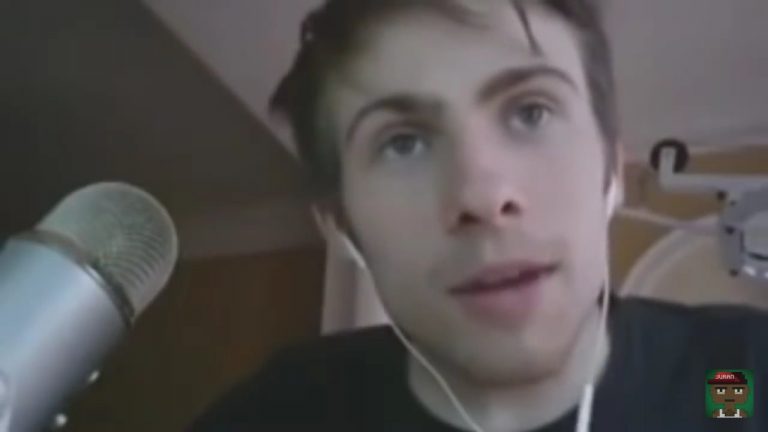
In the freeze frame Shevtsov sits in front of the camera in a black T-shirt. On the left a silver microphone is prominently visible, light headphone wires run downward, and on the right is the light back of a chair. The face occupies the center: lips parted, gaze directed forward. The picture contains no written question, so the familiar line arises in the viewer from memory of the sound.
The frame is tightly cropped and does not show the subject of discussion. This lack of context helps the transfer: almost any news can be placed in front of the blogger's face. The microphone reminds that this is a recording of a conversation, and the facial expression leaves room for a brief pause between what was heard and the reply. It is an image of meme-style surprise, not evidence of the author's attitude toward every caption that other people later added.
Not a request to hear better, but a failure of expectation
An ordinary “what?” may mean the interlocutor spoke too quietly. In this format the question is more often aimed at meaning: the information has already arrived but looks so strange that one wants to verify the very fact of its existence. The profane emphasis makes the bewilderment sharp and colloquial. The video fragment adds a timbre and suddenness that a neutral question mark lacks.
That is why the reaction fits not only shocking news. It can be placed after a rule that contradicts itself, or after a confident explanation of obvious absurdity. A particular pleasure arises when the preceding phrase was delivered calmly: the editing first asks us to accept it as normal, then shows a man who seems to halt the conversation. The brevity of the clip preserves this blow and does not turn the reaction into a separate argument.
Three reasons to stop a conversation
In an invented everyday scene, a friend promises to lend a book but asks for it back before handing it over. Shevtsov's line becomes a response to an impossible sequence of actions. Another example is a recipe advising to cool soup in boiling water: the viewer sees the familiar form of a useful instruction and then runs into a contradiction within it.
In a third situation, a passenger reads an announcement that the train will depart from platform two, which for convenience has been temporarily renamed platform one. The question reacts to an explanation that made a simple task even more tangled. These examples are not from the original video; they show how its small line replaces the whole phrase “I heard it, but now explain how that is even possible.” At the same time, the picture and sound let the bewilderment stay expressive without spelling out a long answer.