What the frame shows
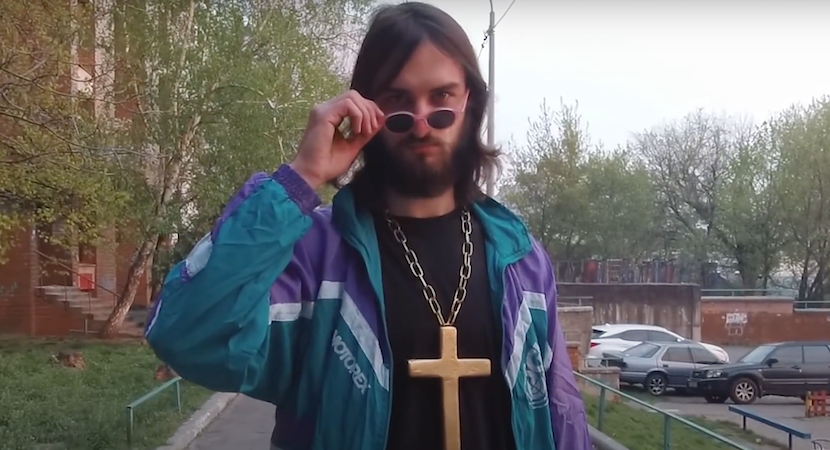
The shot is taken from a music video. In the center stands a man with long dark hair and a thick beard. With two fingers he has pulled a pair of small round glasses with light pinkish frames slightly down and looks at the camera over the top of them. He wears a turquoise and purple nineties-style sports jacket with white stripes on the sleeves, a black T-shirt underneath, and around his neck a thick gold chain with a huge cross hanging almost to his waist.
Behind him is an ordinary courtyard with trees, steps, a brick wall and parked cars. The contrast comes about by itself: the cross and the bearded face evoke an icon, while the jacket, glasses and chain look more like a character from a courtyard music video. It is this contrast that made the frame recognisable even without sound.
Where the song came from
The track is credited to a musician who releases material under the pseudonym Pavel Satanenko. In his own words, quoted in local media, it began as a long-running joke for a narrow circle of friends: he cut out and looped a single phrase from a recording of a sermon by Archpriest Dmitry Smirnov. The date of the track itself is given differently: some sources say 2013, others the 2020 publication, but the song became widely known specifically in summer 2020.
According to the track's author, the video was shot by people from Kyiv whom he had not known before. Press descriptions say that in the clip a man in the guise of Christ rides around the city and behaves in a way very unlike a sermon. It is better not to retell the detailed scenes here: what is known for certain is only that frames from this video ended up in memes.
The fuss around the track
In summer 2020 the Orthodox movement “Sorok Sorokov” (Forty Forties) said it would check the track for offending the feelings of believers, as reported by federal media. The author responded that he considers himself an Orthodox believer and did not want to offend anyone, and that, by his account, he donated the money from Bandcamp sales to charity.
What matters for the meme's history is something else: such a reaction only added listeners to the song. A phrase spoken in a very serious voice and then turned into a rhythmic loop turned out to be funny in itself. Smirnov himself became part of the meme not as a participant in the joke, but as the source of a voice that had been pulled out of context.
How the joke works
The meme rests on a clash of two registers. The first is solemn and churchly: “Lord, Lord Jesus Christ” sounds like a statement that needs no proof. The second is everyday and rhythmic: the same voice repeats over a beat, and the solemnity turns into a chorus. One hearing is enough for the phrase to keep surfacing in your head afterwards.
The frame with the man in the jacket and glasses works as a visual equivalent of this phrase. He looks like someone who has turned up at the right moment and introduces himself without any further explanation. That is why the image suits moments that call for emphasising a confident, slightly cheeky entrance.
Caption examples
Below are several invented variants.
“For an hour the chat argued about what to name the new feature, and then in walks the quietest developer.” The frame works as the entrance of someone who announces the answer in the tone of “case closed.”
“When the question is ‘who ate the last syrniki (cheese pancakes)?’ and out of the kitchen walks the most unbothered person in the house.” The contrast between a small domestic problem and the solemn bearing of the hero creates the joke.
“My cat the moment I open a can of cat food.” The frame stages a solemn arrival of a long-awaited event. The joke is built on exaggerating the importance of the moment.
“The presentation at the team meeting starts with a slide showing a single word in large type.” The frame conveys confidence that nothing needs to be explained.
How to use it and what to keep in mind
The image most often fits as a reaction to someone's showy entrance or categorical statement. Keep the caption short: there is plenty of solemnity in the frame itself, and long text dilutes it. If you need audio, the song itself works for that, and the picture is needed for cases where the sound cannot be played.
Remember that the meme touches on a religious theme, and some believers find such jokes hurtful. So it is better to choose everyday, unrelated scenarios and not turn the frame into mockery of real faith or of specific people. That way it stays a harmless play on the contrast between a solemn phrase and a courtyard setting.