Who Big Russian Boss is
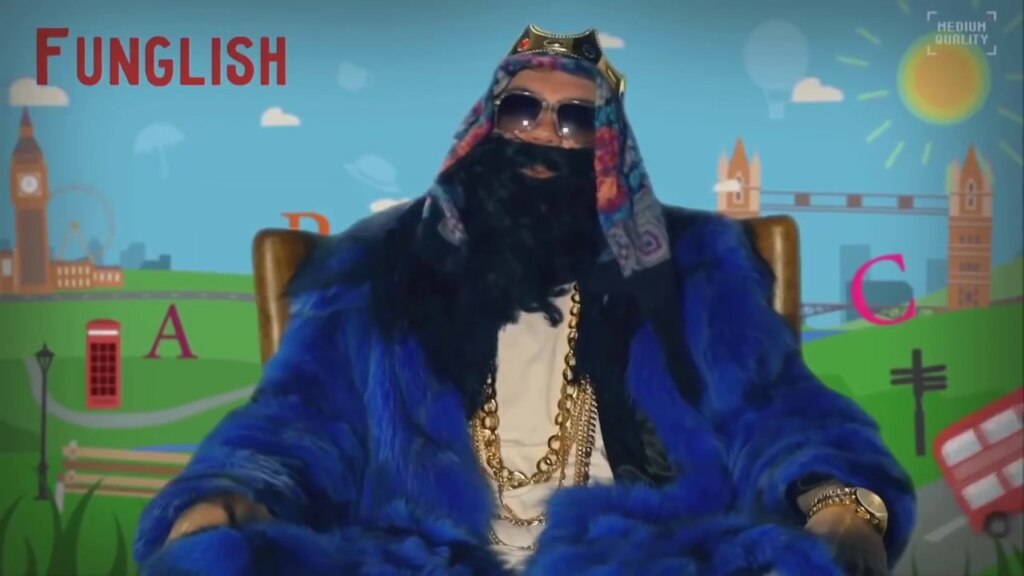
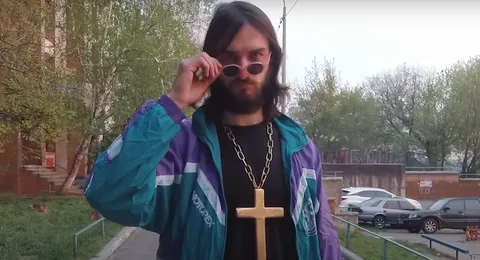
Big Russian Boss is a comedic character known from videos in which he plays a flamboyant "boss" with a grotesque look: a blue fur coat, a thick black beard, dark sunglasses, and massive gold jewelry. The character is built on a parodic delivery and exaggerated confidence, and it's exactly that contrast that creates the comic effect.
The project's exact history, its creators, and the chronology of its episodes have not been confirmed, so the description relies on what's visible in the frame. In the upper left corner of the image is the word "Funglish," and in the upper right there's a video-quality label, both pointing to the format of the show the frame is taken from.
Origin of the phrase
The phrase "but that's not for sure" became the character's signature closer. It's tacked onto the end of a statement after which the speaker himself admits he's not sure about what he said, yet still wants to say it out loud. Because of this, the expression works simultaneously as self-deprecation and as a way to save face without having to retract one's own opinion.
The meme dates to 2015. The exact dates of its first use and the original source video are not known. All that's known is that the phrase is tied specifically to this character and became attached to him within the user community.
How the meme spread
The phrase transfers easily into comments because it consists of two short words and needs no context. It got inserted into discussions where someone made a controversial claim, and people added it to their own predictions or rumors to show that the speaker himself wasn't sure. The trick quickly became recognizable and understandable even to those who hadn't watched the videos.
Bloggers and ordinary users played with the phrase in their own videos and captions, tacking "but that's not for sure" onto the end of their own reasoning. In this way the meme became part of internet speech, where confidence and doubt are expressed together, and the joke lies in the fact that the speaker is simultaneously asserting something and refusing to be held accountable for it.
Ways it's used
The phrase is most often used in three situations: a joking prediction, retelling dubious information, and self-deprecation. In all cases it signals to the listener not to take what was said too seriously, which lets the speaker off the hook for part of the responsibility for his own words.
The expression is convenient because it needs no explanation: even someone unfamiliar with the character understands the meaning from context. That's why it's used in chats, in discussions of videos, and in replies to news where caution needs to be expressed without a long caveat.
Cultural context
The meme belongs to a genre of short marker phrases that get attached to a specific comedic character and then go on to live independently. Such expressions help a community quickly recognize each other and understand shared humor, and they also show how a character can become the source of a linguistic formula for an entire audience.
The popularity of phrases like this on the Russian-language internet is often tied to video content and comments. "But that's not for sure" shows that a phrase can outlive the video itself and start being used by people who have never watched the show but know only its linguistic trace in everyday chat.