A drawing, not a game frame
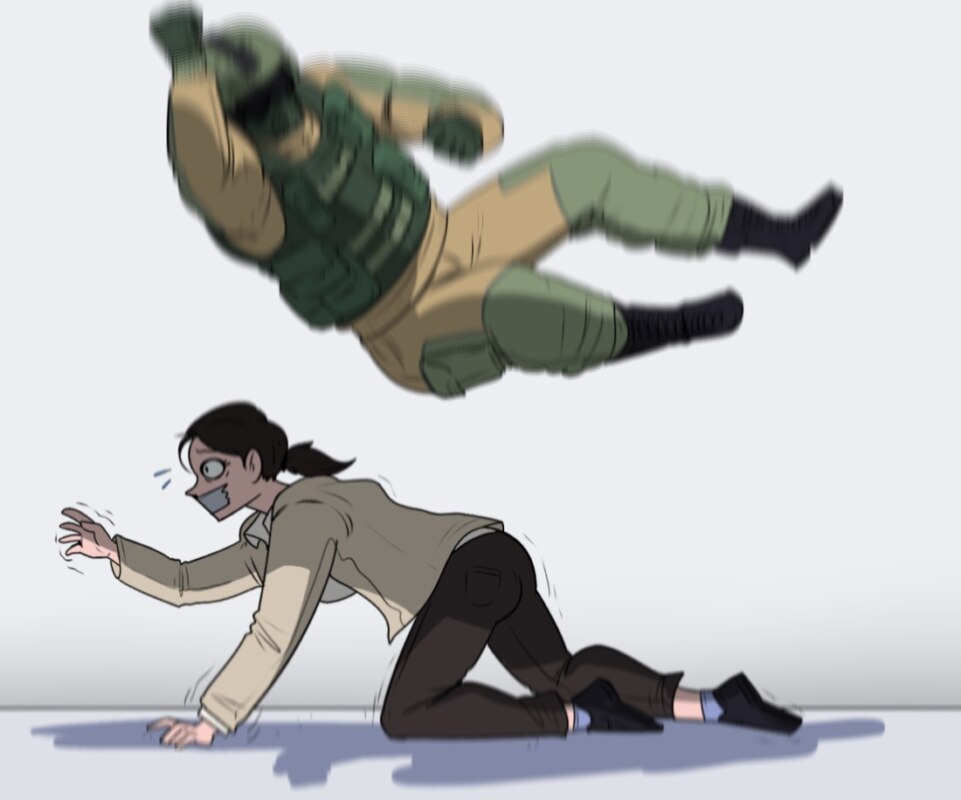
The picture is not a screenshot but a drawn scene on a light background. A figure in a green vest, light green pants with knee pads, and black boots drops from above: the motion is conveyed with blurred outlines, arms raised, legs stretched out. Below, a character crawls on all fours, with dark hair in a ponytail, a beige sweater, dark trousers, and blue socks. His mouth is taped with gray tape, his eyes are wide open, and one arm is stretched forward, as if he is trying to crawl away.
According to the template's name, the falling character is Fuze, an operator from the tactical game Rainbow Six Siege (released in 2015), and the crawling one is a hostage. The frame itself remains a drawing, not footage of gameplay. This matters for captions: the scene is invented, and it can be transferred to any situation.
What is known about the template's history
The drawing spread within the game's community, and then beyond it, in 2019. The name of the artist and the exact date of first publication are unknown, because there is no reliable confirmation. Any dates or usernames from retellings should be treated as guesses.
Among players there's a joke that Fuze can hit hostages with his own charges, and it is often tied to the scene in the drawing. This is a fans' theory, not a confirmed explanation of the picture's origin, and it isn't necessary to understand the template: it reads without knowing the game.
Why the technique works as a template
The strength of the joke lies in the contrast between motion and stillness. The falling figure looks heavy and fast, while the crawling character is almost frozen with fear. The viewer immediately grasps the balance of power: one crashes down, the other cannot get away. That is why the picture transfers easily to any situation with a clear imbalance of strength.
The template also works because the scene has a clear point of impact. The blurred outlines of the falling figure convey speed without a single word. The caption is only needed to name the one falling from above and the one who ended up underneath.
Caption examples
Below are examples written for this template. The first: “When you ask to move a meeting by five minutes, and in response a three-hour meeting drops on you from above.” The imbalance here is not physical strength but scale: a small request is unexpectedly crushed by someone else's schedule.
The second: “Monday versus unread emails.” The formula works through scale: a huge figure above and a small one below turn ordinary routine into a battle.
The third: “A cat that heard the fridge door open.” The falling figure conveys speed, while the crawling character conveys the usual reaction of someone who finds themselves in the way. It's funny because the scene suddenly becomes domestic.
The fourth: “September, which decided there would be no vacation anymore.” This is how exaggeration works: the month takes the role of the attacker, and the person takes the role of the one who can't react in time.
How to use the template
The drawing has two fictional characters, so the template can be used freely as long as the caption doesn't carry the joke over to real people. The tone should stay playful: the picture is about an awkward imbalance of power, not about real violence.
Captions work best when the “falling” one and the “crawling” one are each named with a single word, and all the force of the joke is concentrated in the unexpectedness of the pair. Long explanations only get in the way: the picture already shows everything needed.