what's shown in the picture
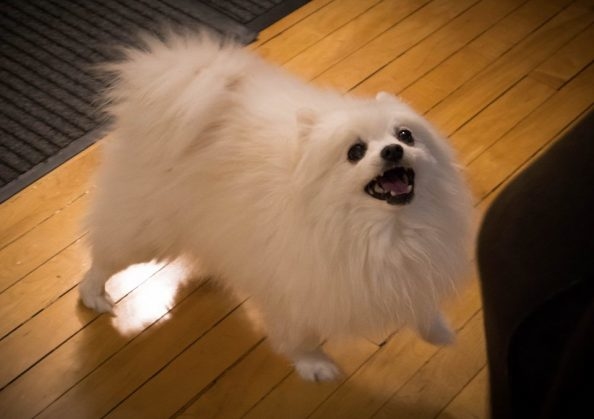
The photo shows a white Pomeranian with a thick, fluffy coat. The dog stands on a wooden floor, looking upward with its mouth slightly open, as if about to say something. That pose and facial expression became the meme's visual key: the dog looks as though it's about to perform another part, and the viewer immediately expects a sound.
The shot itself doesn't convey anything about melodies on its own: it's an ordinary photograph, with no editing or captions. What matters is that the meme rests on the caption and the sound, not on the image. The photo is often used as a thumbnail for videos where the dog "performs" a familiar tune, with the caption explaining that this is indeed that same bark.
The shot is also convenient because it has no extraneous details: the wooden floor, light fur, and open mouth read instantly at a glance, even in a small preview. That's why the image is frequently chosen for thumbnails and stickers, where recognizability matters most.
history and origin
Gabe is a dog who became famous in the mid-2010s for his unusual voice. Users noticed that the dog could bark with a certain pitch and rhythm, which made it possible to edit individual barks together into short melodies. The original recordings were posted online, and from there they were picked up and turned into remixes.
The main feature of these remixes is that fans made them themselves. Users cut out bark clips, matched them by length and pitch, and arranged them into recognizable tunes resembling well-known songs. That's how an ordinary dog became a character whose voice could be listened to like a musical instrument.
how the meme is used
The typical format is a short video where a photo of the dog, or the dog itself, is set to music assembled from its barking. Captions are usually dry and brief: the track's title, or "Gabe performs...". This presentation works as a joke, where the serious tone of the caption contrasts with the funny sound.
The meme also serves as a template for other parodies of "talking" animals. Users often imitate the format, substituting their own sounds or phrases for the barking, and compare the result to the original. That's why Gabe's name often comes up in discussions as a byword for a special canine talent. Such imitations are usually posted in comments and on video platforms, where users trade links and hunt for new variations.
why the meme works
Gabe's comedy rests on the contrast between the dog's serious appearance and what it supposedly can do. The dog looks completely ordinary, but the viewer knows music is playing behind the scenes, which creates a sense of discovery. A fluffy Pomeranian with an expressive face is easily read as the video's star, with no further explanation needed.
The second layer of the joke is the sheer absurdity of the idea. A dog that "sings" using its own barking is both funny and touching at once. Fans treated him with affection, and that reinforced the meme: the videos were less mocking than good-natured.
The meme transfers easily to any subject, which is why it remains recognizable even years later. A single shot and a few sounds are enough for the viewer to get the joke, and that's exactly what makes Gabe one of the easiest-to-grasp dog images in internet culture.