What the picture shows
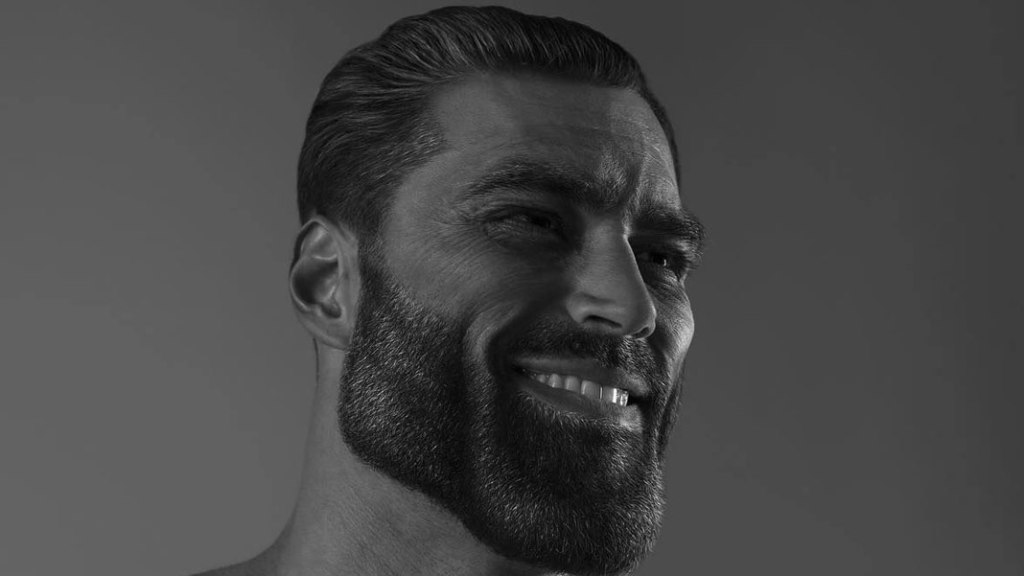
A large black-and-white profile portrait: a man with a short, thick beard and slicked-back hair looks to the right and slightly down, his shoulders bare, and a broad, sly smirk on his face. The lighting is soft, the background dark gray. The hard lines of the jaw and cheekbones are emphasized by the light.
The photo itself is a studio portrait. In memes, however, it is perceived as an image: this is not a facial expression but a whole philosophy, in which calm confidence is what matters most.
It is worth knowing that the original photo was not conceived as a joke: it is a serious studio work in which the light and the pose were deliberately arranged. It became a meme because the exaggerated masculinity in the photo looks almost caricatured, and viewers picked up on this excess as a reason for irony.
Where the photo came from
The photograph was taken by the photographer Krista Sudmalis, and the model was Ernest Khalimov. According to reviews, the series was shot around 2016. In October 2017 the photos were posted on Reddit in a section devoted to bodybuilding, and already on October 16 the word “Gigachad” appeared on an English-language imageboard. It is formed from “Chad,” a playful nickname for a self-assured, handsome, and successful man, and the prefix “giga” (billion).
According to Sudmalis herself, she did nothing to make the photo famous and learned about the meme from friends. At first the meme seemed offensive to her, but later she saw in it a “canon of masculinity.” Some reviews also note that the photographs show heavy retouching, so it is hard to judge the hero's real appearance.
How the meme works
The main device is the contrast between the “ordinary person” and the “gigachad.” On the left is usually an anxious, doubting character; on the right, a person who needs no explanations. The humor lies in the fact that the same fact is perceived differently: what torments one person does not even touch another.
Over time the meme became a universal symbol of confidence: a “gigachad” can be a person, a choice, or a habit. Importantly, the joke is almost always ironic: the hero never explains himself, he is simply accepted as a given. The meme can be either warm praise or satire on the cult of the ideal.
In Russian-speaking communities the word is often pronounced “gigachad” and inflected like an ordinary noun, and the template is often accompanied by a short phrase in the spirit of “just does it.” This is the very pause on which the joke is built: the action is trivial, but it is presented as a feat.
A separate nuance is how the meme reads in different communities. On fitness forums a “gigachad” may be a model to aspire to. In humorous pages it is most often a parody of itself: a man with a perfect jaw wins an argument without proving anything. That is why the template works both for praise and for irony, and the caption determines the context.
Invented captions
The examples were invented for this article. “The one who wakes up without an alarm on a Saturday” versus “the one who wakes up without an alarm on a Monday” is the difference between a dream and reality. “The person who reads the instructions” versus “the person who assembles the wardrobe without them, and it stands perfectly straight.”
“I'm about to have a difficult conversation: a thousand possible replies” and “he: just says one sentence.” There is also a format: “Bought it because it was needed” versus “bought it because it was possible.” Anything where confidence looks simpler than doubt will work.
If you caption such a frame, there is no need to describe the hero's appearance: everyone already sees it. It is better to go straight to the contrast: what the “ordinary person” does and what the “gigachad” does. For a good version, one verb is enough to distinguish two ways of reacting to the same situation.
Tips for use
It is best to use the meme self-ironically: attribute to the “gigachad” habits you would like to be capable of yourself. That way the joke does not turn into mockery of other people.
Do not caption the photo with other people's words about a real person: Khalimov is a real man, and the meme is about the image, not his biography. Short captions and a couple of contrasting variants are enough.