A comic about two perspectives
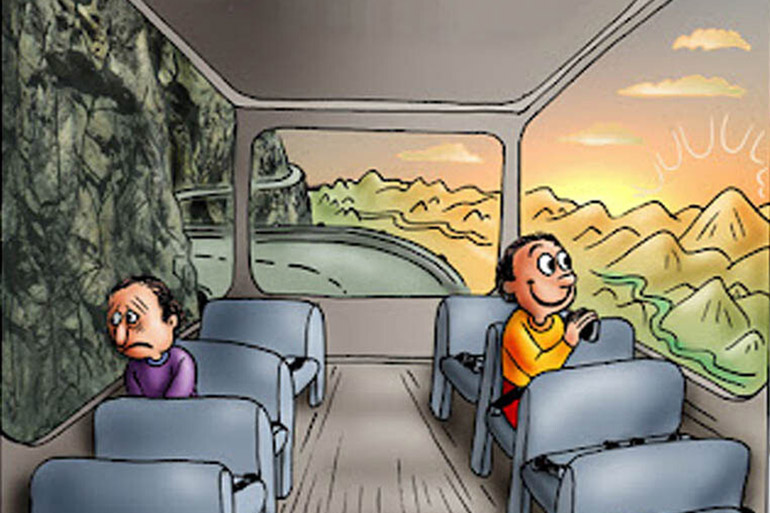
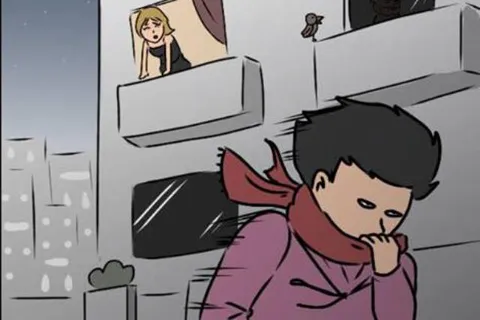
The meme is based on a drawing by Brazilian artist and cartoonist Genildo Ronchi. He said he drew the comic in August 2013, on his birthday; in the original version the idea was that perception depends on the person themselves. International fame came later, thanks to the short format with two passengers: one sees a gray wall outside the window, the other a green landscape.
Viral versions often remove the original caption and replace it with their own comparisons. That is why the picture became universal beyond its original moral. In some posts, the passengers react to the same thing; in others, the “view from the window” illustrates different interests, habits, or expectations. Not every pair of images is an exact copy of the author’s original: there are redraws, localizations, and altered panels.
How the comparison works
The composition communicates the joke’s rule before the caption is read: one person is dissatisfied, the other calm or pleased. The text attaches meanings to these reactions. For example, one audience sees an unwelcome change in a removed feature, while another sees relief from unnecessary notifications. The template thus shows that the same change affects people with different goals in different ways.
The meme is often used as a motivational reminder, but the original picture alone does not prove that a positive attitude will solve an objective problem. An optimistic frame can be useful when the matter is a subjective assessment; it should not downplay a real loss or injustice. Sometimes the joke is especially accurate when the optimist is not “better” at all, but simply interested in a different part of what is happening. Two positions can both be reasonable at once.
Caption examples
“The show dropped the whole season at once: the first passenger misses the weekly discussions, the second is glad to watch at their own pace.” Both reactions are explained by the audience’s habits. “Rain on the weekend: one person is upset that the picnic was canceled, the other finally reads quietly at home.” The picture helps avoid arguing about which emotion is right and instead shows the difference in expectations.
“The app removed an animation: one passenger saved a second, the one with a designer’s eye lost a favorite detail” is an example of how a small update gets two verdicts. For colleagues, you could caption it: “The call was canceled: the one who prepared the presentation, and the one who got an hour of focus back.” Captions should compare comparable reactions; wildly mismatched points break the comic’s visual principle.
When the template fits
Use it for two views on one piece of news, one update, one habit, or one everyday event. First formulate the common subject, then give each passenger a separate criterion for evaluation. Don’t turn one side into a caricature of a fool: the original mechanics are stronger when both positions are recognizable. If the argument concerns facts, the caption must not replace checking with one character’s opinion.
You can redraw the picture, but it is better to keep a clear division of panels and the direction of the gaze. If you are making a workplace meme, avoid using real colleagues without consent and avoid personal characterizations. In an educational post, the template helps explain perspective, but add context: different reactions are not necessarily equal in consequences. A respectful comparison invites conversation, while mockery only reinforces a stereotype. This distinction matters especially when discussing health, income, or social conflicts.