An older question about Luzhkov
The turn has a backstory in Russian political folklore. In 1999, against the backdrop of Sergei Dorenko's election-season programs on ORT about Yuri Luzhkov, anecdotes circulated asking what the Moscow mayor had to do with some new event. The comedy came from constantly returning to a single figure: a story could begin far from Moscow yet still arrive at the familiar accusation. The name changed, but the scheme of an unexpected link remained recognizable.
This parodic question is often remembered as a genuine line of Dorenko's, but that status is not proven. In 2011 journalist Oleg Kashin said he had reviewed recordings of the autumn 1999 broadcasts and found no such familiar formula. So the origin of the phrase is better understood as the audience's reaction to the character of TV polemics. Viewers compressed a recurring device into a short phrase, which proved more durable than individual broadcasts and gradually became usable for new names and topics.
How the question's target changed
The Ukraine version appears in internet publications from 2014. For example, a post on Pikabu combined such a headline with a reference to Kipling. Initially the phrase could accompany political comparisons and mockery; later it began to parody the very habit of finding a link to Ukraine in stories far removed from it. This let the same question sound both like a hint and like a remark on the absurdity of hinting.
In May 2018 a notable wave consisted of comments on VKontakte under blue-and-yellow images. The joke no longer required a political event or a long analogy: a combination of colors resembling the Ukrainian flag was enough. Many such pictures had a completely independent meaning before the caption appeared. The meme added an artificially important question to an everyday object, and the mismatch between the object and the interpretation became the basis of the humor.
The parrot as an accidental color clue
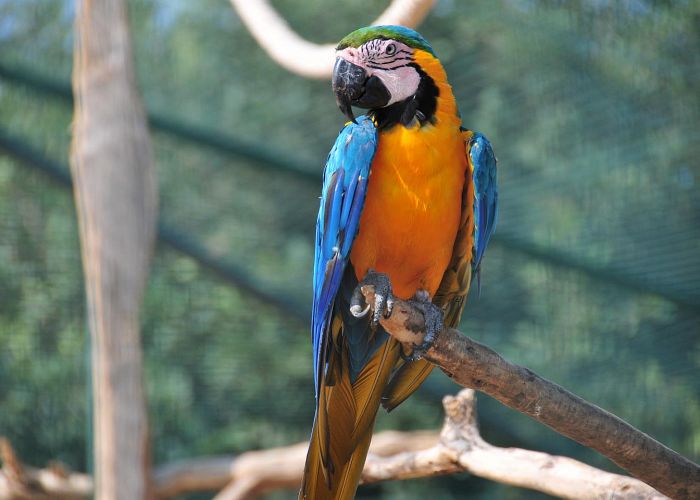
In the photo, a parrot sits on a sloping branch. Its wings and part of its back are blue, its breast is yellow-orange, and a blurred green background is visible. There is no text in the photo, and no state symbols appear near the bird. The photographer and the first publication of this variant are unknown. The connection to the meme arises through the bird's conspicuous plumage colors, not through the place of shooting, the bird's affiliation with anything, or any hidden story in the photo.
A question with a predetermined answer
An ordinary question about a connection presupposes that it must be explained. Here the reader often already knows the answer: there is no real connection apart from color or a superficial coincidence. The words 'at first glance' create the expectation of a clever line of reasoning, but instead a parrot is presented. The result is a small parody of an analytical conclusion. The meaning also depends on context: a question under a news item may dispute its argument, while under a photo of an object it usually mocks the excessive seriousness of the association hunt itself.
Blue-and-yellow finds in invented scenes
In the first invented example, a person brings a yellow mug to work and sets it on a blue coaster. A colleague asks the meme question, as if he had discovered an international plot in the tea service. In the second invented variant, a photographer shoots a blue jacket against a field of dandelions and captions the frame with the same phrase. The color match turns into an exaggerated discovery, although the viewer sees an ordinary walk.
The third invented scene moves the question into a game: a hero collects yellow coins against a blue sky, and a commentator starts looking for a political scheme in the level's palette. In every case the object is easy to name without any geography. This independence makes the added association funny: a mug, clothing, and a game background become a pretext for showing how quickly a random resemblance can be passed off as an intentional connection.