Three frames on a dark screen
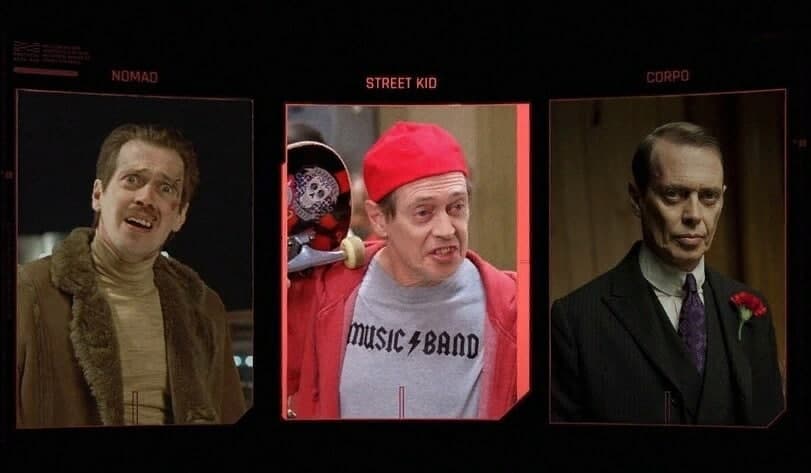
The picture is a stylized selection screen: three vertical frames on a black background with red lines. Above the frames are the English labels: Nomad on the left, Street Kid in the middle and Corpo on the right; the middle frame is highlighted and brighter than the others. The frames hold three photos of the same man in different looks. According to descriptions of this template, he is the actor Steve Buscemi, whose roles in various projects became one of the first popular versions of the format.
On the left he wears a fur-collared coat and a sweater, with a bewildered face and a mustache. In the center he wears a red cap and a red hoodie, with a skateboard on his shoulder and a gray T-shirt reading “Music Band.” On the right he wears a dark suit with a tie and a red carnation, with a cold, hard stare.
Where the screen comes from
The original is the origin-selection menu of the character in Cyberpunk 2077. It was shown in a trailer released on August 10, 2020, and the game itself came out on December 10, 2020. The game offers three options: Nomad, Street Kid and Corpo, that is, a wastelander, a kid of the streets and a corporate employee.
The earliest known remake appeared on August 12, 2020, two days after the trailer: the game's Twitter account filled the frames with starter Pokémon. After the release the format became especially popular among Russian speakers, first on VKontakte, then on Twitter, Reddit and Instagram.
How the template works
The idea is simple: three frames are filled with three states of one hero. As in the game's choice, they have distinct characters: weak and strange, bold and streetwise, strict and calculating. The viewer reads this gradation at once, because they know what each type looks like.
Sometimes the frames are used for a person's career path or a character's arc: from awkward youth through a rebellious phase to respectability. There is an extra layer of irony as well: in the game, the choice of background mainly determines the prologue and some of the lines, so a joke about a “defining” choice gains extra meaning.
Caption examples
You can caption the frames yourself: “Cat at 6 a.m.,” “Cat during the day,” “Cat in the kitchen when the fridge opens.” Replacing the frame labels makes the template universal.
Another version: “Me before coffee,” “Me after the first mug,” “Me at 5:55 p.m. on a Friday.” Here the sequence does the work, and the joke gains strength by the last frame.
You can also break an object down by genre: “Horror movie: trailer, opening, credits.” The frames accept objects too, not only people.
And a variant about habits: “Plan, do, postpone.” The point is that the third word is the most accurate.
What all the variations share
Good variations of the template rest on a gradation. The left frame is usually the most absurd or weak, the middle one provocative and loud, the right one serious and cold. If the images are arranged at random, the joke loses its direction and the viewer doesn't know where to laugh.
Another successful scheme is to show three stages of development: before, during and after. Then the choice becomes not a comparison but a short story.
Tips for using it
Change what is in the frames rather than the frames themselves: it is enough to swap the pictures and keep the original labels Nomad, Street Kid and Corpo, or replace them with your own. What matters is that the three images clearly differ from each other.
If you use a photo of a real person, pick a public figure and neutral comparisons: the joke should be about the images, not about someone's personal life.