Two frames, one street
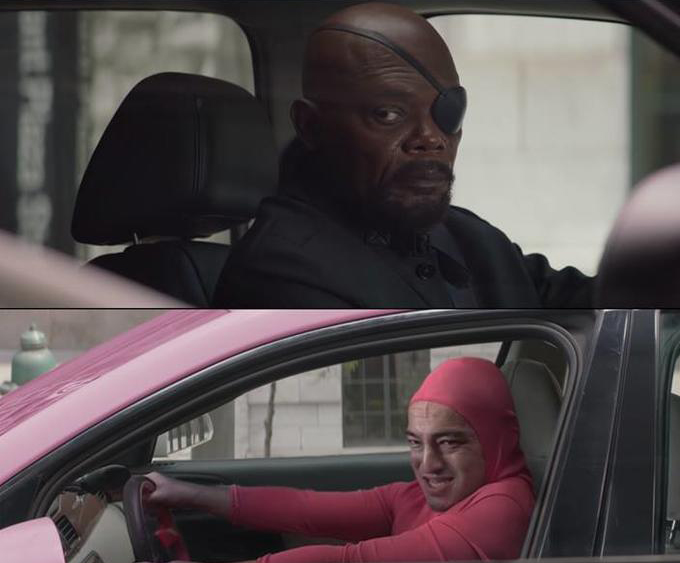
The upper frame is dark: a man with an eye patch, dressed in dark clothing, sits behind the wheel of a car and glances to the side, past the camera. The lower frame is light and bright pink: behind the wheel of a pink car sits a person in a form-fitting pink suit with a hood covering the head. He smiles broadly and holds the steering wheel with both hands.
This version has two panels. For the caption it is worth relying on the picture itself: the upper panel shows the one who is looking, and the lower panel shows the one or the thing he is looking at.
Where the frames come from
The upper frame is taken from the film “Captain America: The Winter Soldier” (2014). Nick Fury is played in it by Samuel L. Jackson. The character sits in a car on a city street, and his restrained sideways glance creates a serious, wary tone.
The lower panel was added separately: it is the character Pink Guy from the web series The Filthy Frank Show, recognizable by the pink hooded suit. The contrast between the serious hero of the film and the absurd internet character became the basis of the template.
How the caption format took hold
The meme spread in 2019, including through Facebook and Reddit. Several early versions are known, but the exact first post and its author have not been established from open sources, so it is better to speak of a period of popularity rather than a specific date.
Over time a version took hold in which the character captions an object or creature in the frame: Fury “sees” what is written underneath. In this way the format acquired the label of “captioning objects” and began to be applied to any unexpected things in a serious setting.
Caption examples and why they work
Example 1: “The kettle that promised to boil in a minute, and now has been silent for an hour.” The caption is addressed to an object, not a person. The hero's gaze is serious, and it is funny that his attention is given to a kettle behaving strangely.
Example 2: “The alarm clock that switched on on Saturday without an order.” An alarm clock should not ring on a day off, and the hero's reaction looks like an official investigation.
Example 3: “The box with instructions that no one has opened since the purchase.” A household item turns into a suspect, and the solemn expression contrasts with the modest object.
Example 4: “The refrigerator that quietly hums all night, although no one asked it to.” The object does something unsolicited, and the character looks at it as if it were a breach of the rules.
How to apply the format
The template works well when the caption names an object, an event, or a behavior rather than a specific person. If the target becomes a real individual, the format turns into mockery that may hurt a particular person, so such variants are better avoided.
To make the caption sound natural, one specific observation is enough. The serious look in the frame already sets the tone, and any extra explanation only gets in the way. A short phrase that precisely names what is wrong with the object is best.
Another workable device is a list of absurd “suspects”: the more mundane the object, the stronger the effect. For example, a sock without its pair or a constantly blinking router look more convincing in this role than something obviously strange.