What is visible in the frame
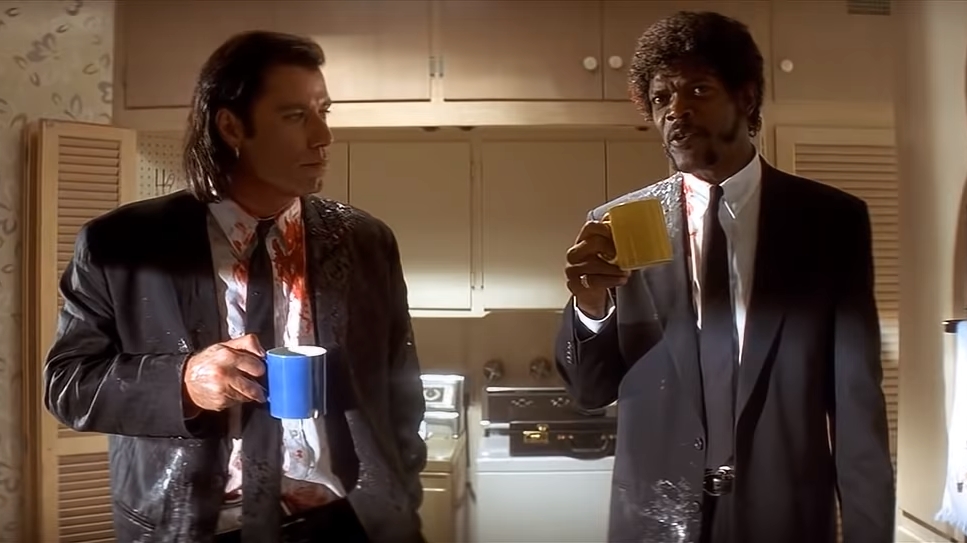
On the left is a man with long dark hair in a dark jacket, holding a blue mug and looking toward his companion. On the right is a second man in an identical dark suit and tie, raising a yellow mug. Red stains are visible on their shirts, and the jackets show wet glints, as if the fabric were splattered with liquid.
In the background are light kitchen cabinets, a blind-covered door on the left, and a white stove with a briefcase on the right. The lighting is warm and the interior is domestic, and it is this ordinariness next to traces of recent events that makes the frame recognizable.
The scene at Jimmy's house
The frame comes from the episode where two characters, Vincent and Jules, arrive at Jimmy's house to solve a problem connected with what happened in the car. Jimmy, played by director Quentin Tarantino himself, is nervous: his wife is due back soon, and the tension in the scene is constant.
At this point Jules tastes the coffee he has been served and unexpectedly praises it with solemn gravity. For the meme, it is this praise, delivered in the middle of an anxious setting, that matters. The rest of the episode barely figures in the joke: it is enough to know that the conversation about taste happens right beside a much more serious matter.
Why the praise is funny
The comedy comes from contrast. The character speaks calmly and even with enjoyment, while a grim story goes on alongside. The viewer hears a serious tone, sees the stains on the clothing, and realizes the topic of conversation is entirely out of step with the setting.
The Russian caption softens the original line: instead of a harsh word it uses the mild exclamation “damn.” Thanks to this, the phrase is easy to use in ordinary everyday jokes without tipping into crudeness.
Examples of captions
Example one: “A third cup of vending-machine coffee at five in the morning. A serious choice for a true gourmet.” An everyday trifle gets a solemn rating, and the gap makes the caption short.
Example two: “A friend asked why you bought this nine-ruble tea bag. A serious choice for a true gourmet.” Here the praise is offered as a reply to a reproach, and the irony comes from the calm tone.
Example three: “Pineapple on pizza after midnight. A serious choice for a true gourmet.” The coffee scene moves into a kitchen choice, and the drama remains only in the tone.
All three captions follow one pattern: a small thing, a grand word about taste, and no softening. The more mundane the object, the stronger the contrast between the frame and the text.
How to use this template
The frame suits irony about tastes, habits and the importance of trifles. It is best to keep the same level of softness as the Russian caption: otherwise the joke slides into crudeness it does not need.
The stains on the shirts in the frame are heavy in themselves, so the template should not be used on topics of real violence or other people's suffering. It works as comedy when the viewer remembers that something quite different is happening beside the coffee, and keeps that distance.