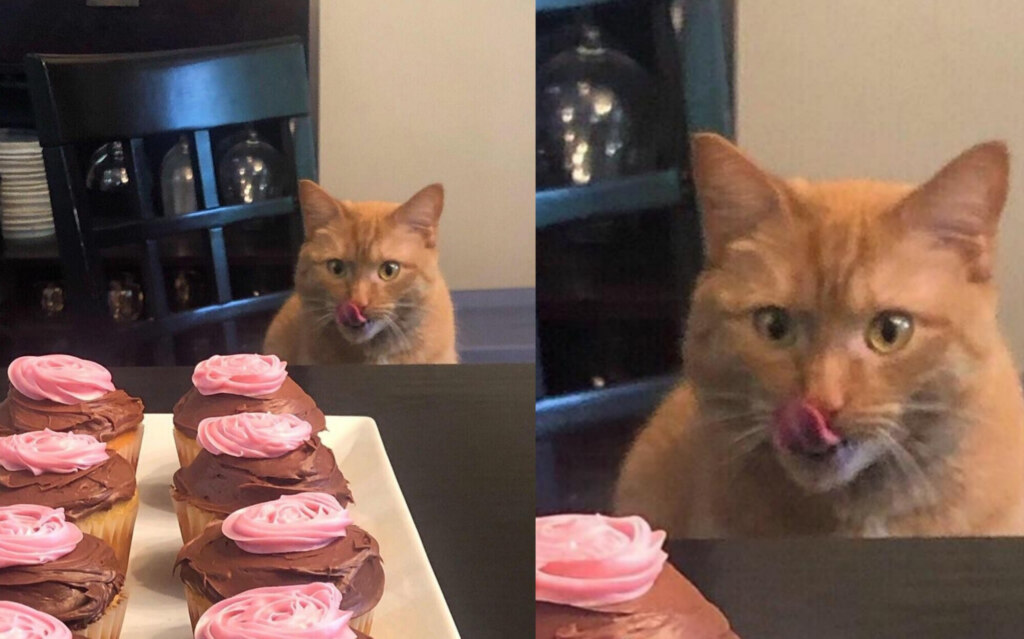
What the two frames show
The collage consists of two panels. In the left one, a ginger cat sits at a table; only his upper part is visible: pointed ears, yellow-green eyes, and a pink tongue with which he licks his nose. In the foreground is a plate of cupcakes: chocolate cream at the bottom and a pink icing rose on top. The background is dark, and behind the cat you can see a cabinet with glass dishes and the edge of a chair.
In the right panel, the same cat is shown in close-up. He looks almost straight into the camera, his tongue sticking out right at his nose, and the edge of a cupcake is visible in the lower corner. The two frames work as a zoom: the viewer first sees the whole situation, then looks at the cat almost up close.
The origin is unknown
The original source of the collage, the photographer's name and the shooting date are not established. So it is impossible to say who took these frames and when, and any stories about the cat's owner or the shooting location would be speculation. One can only describe what is depicted and how the template is usually used.
This is a normal situation for everyday pet photos: the picture is taken for personal use, it spreads into other people's reposts, and the link to the author is lost before the frame becomes a template.
Why the gesture is funny
Cats rarely look greedy, so licking at a plate is perceived as a human emotion transferred onto an animal. The cat sits calmly, but his tongue betrays a desire he cannot express in words. It is precisely the mismatch between the calm pose and the obvious gesture that creates the smile.
The pink icing on the cupcakes also plays a role: the bright color makes the dish the center of attention, and the cat becomes an observer who cannot approach yet. This scheme is familiar to many: the goal is visible, but it has not been obtained yet.
Caption examples and analysis
Below are three invented caption variants for this collage.
1. “Observation mode: looking at the cupcakes, touching nothing, but the tongue is already working.” The caption admits a boundary (“touching nothing”) and immediately refutes it with a gesture. The viewer understands the decision has already been made while the hero pretends to restrain himself.
2. “Just one, they said. Meanwhile I'm counting how many there are on the plate.” Here the verbal prohibition turns into the cat's own action. The counting within the caption paints the picture of someone who calculated everything in advance.
3. “When they say sweets are bad for you, and the rose on the icing is so pretty.” The example uses the contrast between a sensible piece of advice and the emotion the picture evokes. The second half of the phrase sounds like an excuse, so the laugh arises at the junction of two thoughts.
How to use the template
The two-panel scheme suits the story “from interest to action”: first the general view, then the close-up. If you need a simple reaction, it's better to take only the right panel, where the gesture is most visible.
Keep captions short: two or three words per part work better than a long paragraph. The frame requires no references to specific people, so it is convenient to use in any context involving desire and self-control: a diet, discounts, the last slice of pie, a long-awaited purchase.