Cat, plate and a hand at the edge of the frame
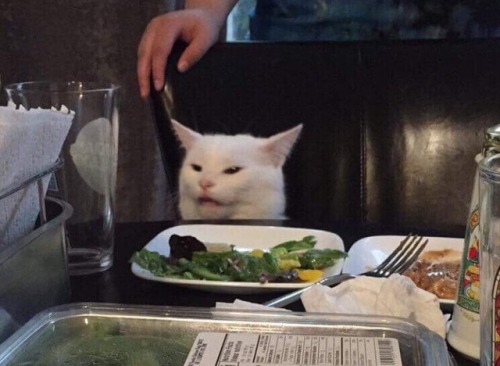
In the frame, a white cat sits at a dark table. Its face is in the center of the shot: the ears are slightly flattened, the mouth is slightly open, and the gaze is directed forward. In front of it is a white plate with salad leaves and yellow pieces. At the top left, a human hand is visible; on the right, a second plate with food and a fork lies nearby.
At the bottom of the frame, a transparent box with a label is visible; on the left are a glass and paper napkins. These details are not important to the joke, but they explain why the photo looks like an ordinary dinner shot rather than a staged one. The cat’s expression is read first, and the rest of the background only emphasizes its bewilderment.
The photo that went around the internet
According to reports, the photo was first published on Tumblr in June 2018 with the caption “he no like vegetals,” meaning “he doesn’t like vegetables.” At that time it was an ordinary funny pet photo: the caption explained the cat’s facial expression as a whim.
The photographer’s name and the exact circumstances of the shoot are unknown. The date of the first publication should also be considered approximate.
From the frame to the template
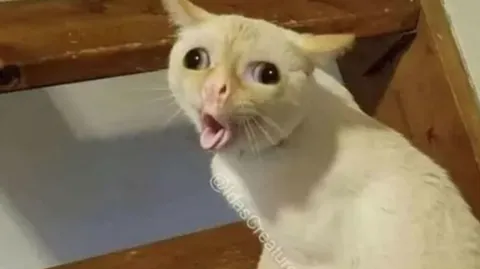
The meme’s main life began with a paired format. The frame is placed next to a photo of a person who is shouting something or arguing emotionally, and the cat’s gaze becomes a comment on someone else’s reaction. According to reports, the first known pair of this kind was posted on Twitter in early May 2019, after which the format spread quickly.
It is important to separate two stages: the appearance of the cat photo and the appearance of the paired meme. The first belongs to 2018, the second to spring 2019, and there is no need to merge them into one story. The cat remains a passive hero in this story: the meaning appears only next to someone else’s emotion.
Captions that rest on the gaze
The examples were invented for this article. Each line is built so that the interlocutor’s reaction looks exaggerated against the calm cat.
“They said there would be a surprise. The surprise is dinner with vegetables.” The cat acts as a spectator who has been served something it did not order. It is funny because the scale of the promise and the modesty of the dish do not match.
“Asked to make it a bit spicier.” The pause between the request and the cat’s face is the key moment: the viewer finishes the answer in their own head, and it is usually shorter than expected.
“When someone in the chat asked who would wash the dishes.” The cat embodies complete indifference, and the irony is that the question provokes an emotion that is absent from the frame.
The general rule is one: the emotion in the caption is stormy, and the cat answers with a single look. The stronger the contrast, the shorter the text can be.
Where the template fits
The photo is convenient wherever there is a reaction to which one can respond with silence: a failed joke, a strange choice on a menu, a drawn-out argument. The caption should be shorter than the image, because the cat has already shown the emotion, and the text only sets up the scenario.
It works best when a frame with a vivid emotion is placed above, and the caption names the smallest reason for that emotion. The smaller the cause, the stronger the contrast with the cat’s calm look.