What the picture shows
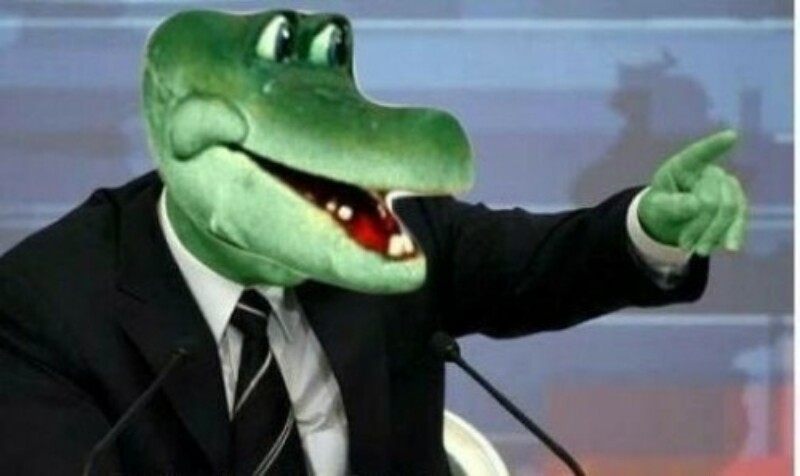
This is not a still from a cartoon but a montage. The green head of Gena the Crocodile has been pasted onto the figure of a man in a dark jacket, white shirt and dark tie. The body is turned to the right, the right arm is extended with a finger pointing off to the side. The mouth is open wide enough to show teeth and a red tongue, the eyebrows are raised and the eyes are wide open.
Two thin black microphones on stands stand in front of the character, and the blurred background is tinted blue and lilac, like a panel at an official meeting. The result is a speech or press conference scene: the “speaker” is not just saying something, but demanding immediate action. The montage error, where the head stands out slightly in style from the photo, only adds to the absurdity.
Who Gena really is
Gena the Crocodile first appeared in the books of Eduard Uspensky: the story “Crocodile Gena and His Friends” was published in 1966. On screen the character became famous through the puppet and animated world of the Soyuzmultfilm studio: the cartoon “Crocodile Gena” came out in 1969, directed by Roman Kachanov, and its sequel “Cheburashka” appeared in 1971. Gena was voiced by Vasily Livanov.
In the story, Gena works as a crocodile at a zoo, plays the accordion and sings a song about a blue carriage, and most importantly, he looks for friends and finds Cheburashka. He is a model of kindness and politeness, and the joke is built on that: the gentler the original, the funnier its “prosecutor” version looks.
Where the phrase came from
Reportedly, the meme appeared in January 2010 on a Russian-language imageboard. The author of the montage is unknown, and the first publication cannot be confirmed: one can only point to the earliest known place of distribution. From there the picture spread to large communities and humor pages.
The choice of hero is explained by a wordplay: in colloquial speech “crocodile” is slang for a dangerous homemade drug, so a green crocodile as the one who “catches the junkie” sounds absurd and provocative. The topic is serious, and the joke does not apply to real people: what is funny is the incongruity of a children's hero playing the strict enforcer of order.
Come up with your own caption
Below are three independent examples showing how the template works.
“Catch whoever wrote ‘let's talk later’ in the group chat and disappeared.” A household trifle is elevated to the level of a criminal case, and the shouting amplifies the scale.
“Catch the author of the alarm clock that rings before the sun is up.” The culprit is abstract and non-existent, so the accusation stays harmless.
“Catch whoever ate the last slice of cake and put the empty box back in the fridge.” The specific detail matters here: the more detailed the “crime,” the stronger the comic effect.
How to use the template
The picture works best with a caption in the form of a short order, and the text should name a target of the joke nobody will mind: an object, a habit, a situation. The caption fits well on the dark part of the suit at the bottom, or in the upper right corner where the background is calm, and should not cover the head.
Do not caption photos of real people this way or seriously accuse anyone of drug use: then the joke turns into an insult. The template works well with a mild topic; serious grievances quickly spoil it. If you want to boost the effect, just add a repeat, for example “catch, catch!”, rather than writing long explanations.