Two frames, one scale
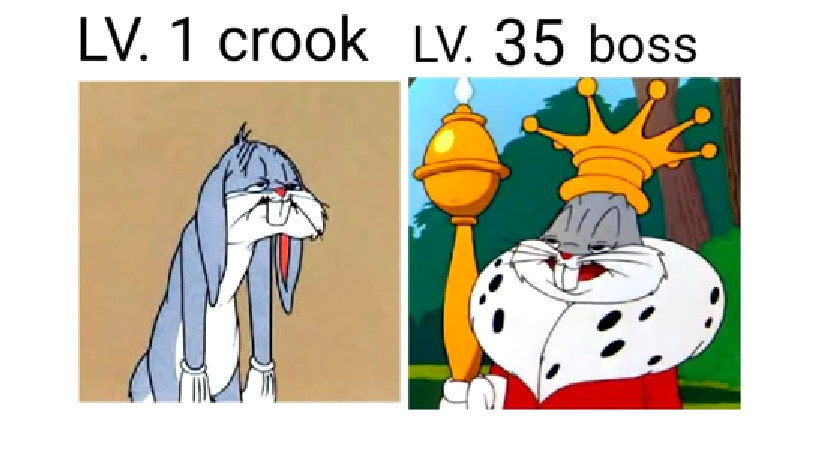
The image shows two pictures side by side. Above each is a caption: on the left “LV. 1 crook,” on the right “LV. 35 boss.” On the left is the gray rabbit Bugs Bunny from the Looney Tunes cartoons, against a plain brown background: he is hunched, his ears are drooping, his tongue is hanging out, and his pose is tired. On the right is the same character in a golden crown, holding a heavy staff, wearing a white fur cape with black spots and a red robe, against a green forest background.
The captions set the rule for reading: the first picture shows the start of the journey, the second the result of leveling up. The meaning rests on the composition: a sharp change of pose, clothing, and background, and two identically styled captions standing side by side like rows in a stats table.
The ad the captions came from
The phrases “Lv. 1 Crook” and “Lv. 35 Boss” are reportedly linked to an ad for the mobile strategy game Mafia City. It was released in 2017 on Android, iOS, and Windows, and the developer and publisher is listed as Phantix Games. In 2018 the game was actively promoted with short YouTube videos, and the videos themselves became a subject of jokes.
The line “That’s how mafia works” from the same ad series was, as the press reported in January 2019, one of the most noticeable memes of the month. Who first combined the captions with the Bugs Bunny frames is not reliably established, so it is impossible to name a specific author of the template.
Why the level contrast works
The numbers “1” and “35” are familiar to anyone who has played games with leveling: the level shows how much experience and power a character has. The joke is that this language carries a whole human story into a stats table. The hero does not become smarter or kinder; he simply gets a higher number and a new look.
The pause between the two pictures works best. The viewer sees the exhausted rabbit and immediately compares him with the golden crown and the fur. The humor lies in the mismatch between expectation and result: usually leveling up changes a sword or armor, but here everything changes, including the character's mood.
Caption examples and how they work
Below are invented examples. For a caption to work, you need two levels of the same hero and a noticeable difference between them.
“Lv. 1 — a newcomer who opened the documentation. Lv. 35 — the one who writes it.” The first line sets a low level through a familiar action, and the second reverses the expectation: the reader grows into the author.
“Lv. 1 — me on Monday morning. Lv. 35 — me on Friday evening after a bonus.” Here the levels are tied to time. The contrast rests on the recognizable rhythm of the week.
“Lv. 1 — a cat asking for food. Lv. 35 — a cat who has already ordered delivery.” The example shows that the template also works with animals, as long as the “was — became” formula and the same hero are kept.
When this template fits
The picture suits stories of growth: a first successful project, a career change, mastering a new skill. It is important that the second picture looks clearly better than the first, otherwise the joke loses its point. The caption should be short, because the frame itself already sets the pace.
Do not tie the template to a real person and their failures: the formula describes a situation, not a biography. If the joke concerns a specific acquaintance, it is better to rewrite the first line as a general situation that many people will recognize.