How the drawing is assembled
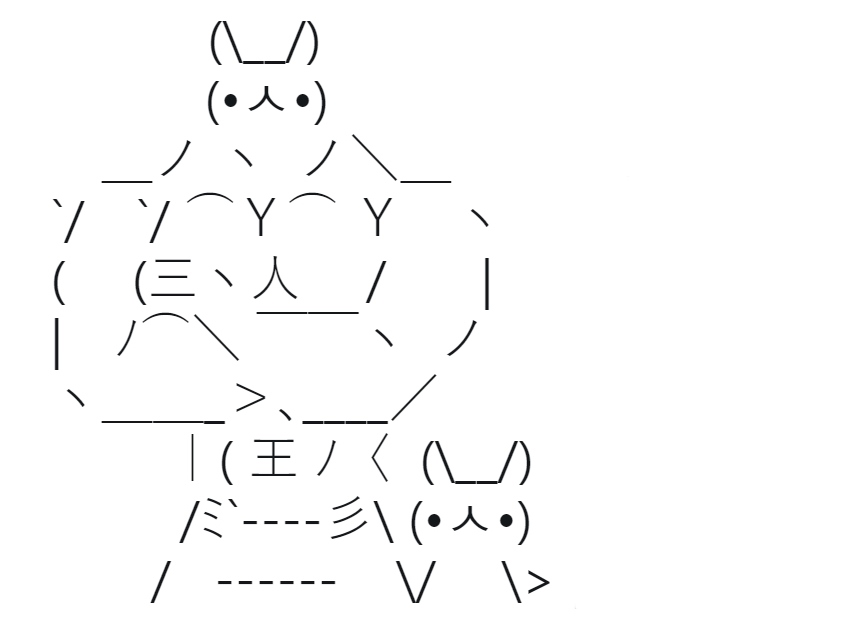
The large bunny takes up almost the entire field. Above its head are the ears “(\__/)”, and its face is typed with the characters “(•ㅅ•)”. The body is laid out from brackets, slashes, check marks, and symbols from various writing systems, and a character “王” is visible at the waist. The dense texture makes the figure massive: the shoulders are wide, the arms are bent, and the bunny appears to be packed more densely than anything else.
The small bunny is placed at the bottom right. It has the same ears “(\__/)” and the same face “(•ㅅ•)”, while its body is only suggested by a short mark “\>”. It fits into the corner of the sheet, so the eye goes first to the large figure and only then notices the second character. The identical faces matter: these are not two different heroes, but one and the same bunny at two scales.
The text bunny and an unknown author
The face “(•ㅅ•)” belongs to a family of text emoticons assembled from keyboard characters and symbols of other alphabets. Such drawings are easy to copy: they can be pasted into a message whole, without attaching a picture, so they survive forwarding and reposting almost without loss.
The author of this muscular version and the exact date it first appeared are not established. Reportedly, similar drawings circulated on social networks in the late 2010s, but a reliable first post cannot be named. Therefore, below we describe only what is visible in the image itself and how it is customarily used.
Why the contrast works
The joke rests on scale. The large bunny looks confident and ready for action, while the small one almost disappears beside it. The viewer compares the two figures instantly, and no explanation is needed: the difference in size already says everything.
The drawing allows two readings. If the large bunny is protecting, then the small one is the one being protected, and the picture turns into a metaphor for support. If the large one simply dominates, the result is irony about an overly confident character who does not notice that someone very small is right beside it. Which reading to choose is decided by the caption.
What roles can be assigned
Most often the template divides the world into “big” and “small”: decision and doubt, experience and newcomer, main task and minor nitpick. The caption for the large bunny speaks of strength, while the caption for the small one speaks of how insignificant it looks next to that strength.
It works well when both captions are short. One word or a short phrase per bunny is enough, because the picture already takes up a lot of space and leaves no room for long text.
Captions for two bunnies
The examples are written for this template.
Large: “My plan for Monday.” Small: “Your plan for Monday.” The difference in size turns into a joke about readiness, and the caption reads well in a work chat.
Large: “Appetite after a workout.” Small: “A cafeteria portion.” The contrast between desire and reality gets a visual form, and it does not need to be explained.
Large: “My enthusiasm in January.” Small: “My enthusiasm in February.” Here the drawing shows how strength changes over time, and the funny part is the recognizable habit.
When the contrast fits
This meme suits differences in scale, strength, or confidence: games, work tasks, sports, everyday comparisons. The visual contrast explains the joke at once, and the text stays short.
Do not turn the drawing into an assessment of real people. The bunnies here are symbols, and the caption is best tied to a situation, a role, or an action, not to someone's appearance, health, or personal life.