What is visible in the screenshot
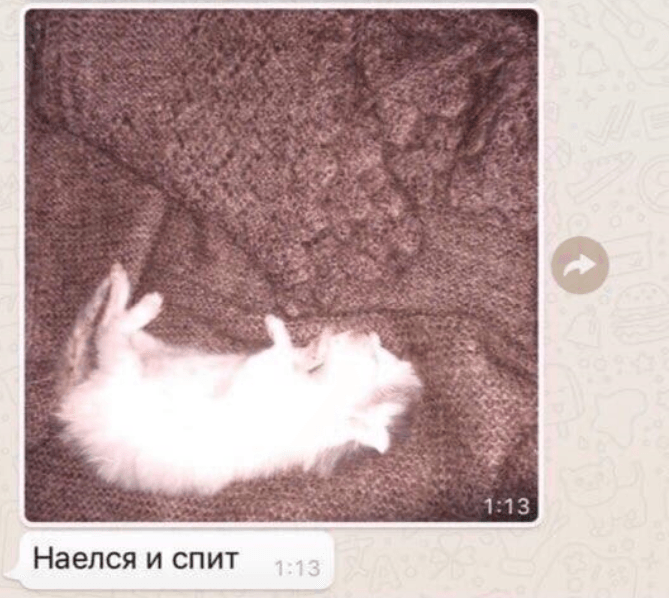
The image looks like a fragment of a conversation: on a light background with the pale patterns of a messenger, there is a bubble with a photo at the top and, below it, a text bubble reading “Ate and sleeps.” In the lower right corner of the photo, and next to the text, the same time is shown: 1:13. To the right of the photo, there is a gray circle with a “forward” arrow.
The photo itself shows a dark brown coarse-knit blanket, with a small white fluffy kitten curled up on its side. The flash overexposes the fur, so the outlines blur and the kitten looks like an almost glowing spot. Its paws are tucked in, its face is not visible, and from its pose it is clear the little creature is asleep.
The quality is low: the shot was taken with a flash in a dark room, the colors are harsh, and the graininess suggests an old camera or repeated re-saving. For the joke, this is a plus, because this is exactly how a real conversation looks, rather than a template invented in advance.
Where the frame came from
The author of the screenshot, the recipient, the date, and the original conversation could not be established. It is generally assumed that this is an ordinary message from a person looking after a pet, but there is no confirmation: nothing in the frame itself implies this.
The time 1:13 can be interpreted in different ways, and every explanation would be a guess. For the joke, something else matters: the message was sent late at night, and the sender still considered it necessary to report back.
Why it is funny and touching
The joke has two layers. The first is the simplest: one phrase contains everything you need to know about the pet's condition. The subject is omitted, the verbs are in the masculine form, and the message reads like a brief summary. The reader instantly understands that the news is good.
The second layer is the contrast between a dry, “official” style and the tenderness the kitten evokes. In this phrase we hear not indifference but relief and care. That is why the template is often applied not to animals but to people: a sleepy child, an exhausted colleague, oneself after lunch.
The grammar matters too: “ate” and “sleeps” are two simple verbs in a row, with no punctuation or emoji. In chat, people write this way when they lack the energy for details but very much want to reassure the other person. Any added word turns it into ordinary chatter.
Examples for your own caption
“When asked how my project was going: ate and sleeps.” The project turns into a well-fed pet, and the answer responds to the question without giving any information.
The same phrase fits a piece of tech that spent a long time “eating” resources and then calmed down: “A laptop that spent a day downloading a 12 GB update. Ate and sleeps.” After its voracious download, the computer finally goes quiet, just like a well-fed pet.
“Budget report after payday: ate and sleeps.” A joke that the money is gone, but the state of affairs is good.
“What the whole team does after a release.” The same two words, but now they are a collective portrait.
How to use the template
This screenshot works best without changing the text: only the thing it is laid over changes. You can swap the phrase for another short one while keeping the tone of a “summary”: “Got home, asleep,” “Fixed it, silent.”
Do not overcomplicate the caption: the template rests on brevity. A long explanation would destroy the impression that this is a real late-night conversation, and the joke would lose its main point.
One more technique: place the caption under a photo not of a pet but of an object that does not fit the phrase, such as an exhausted boss in a meeting, an overflowing laundry basket, or a printer that doesn't work. The further the object is from the kitten, the stronger the sense of surprise, while the familiar tone of care remains.