The event before UFC 223
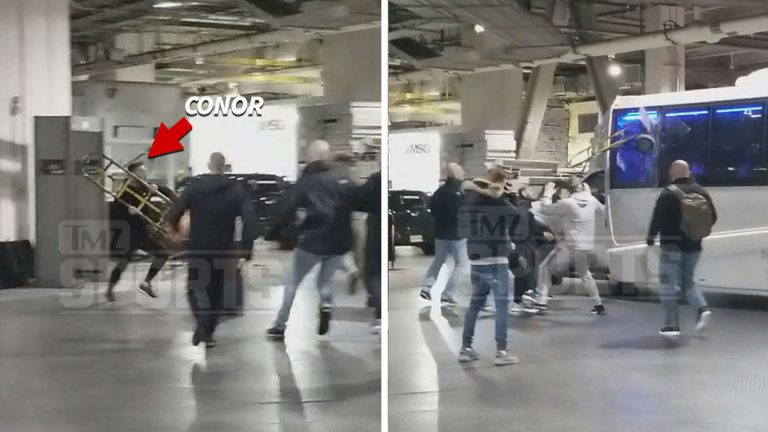
On April 5, 2018, at the Barclays Center in Brooklyn, after media events ahead of UFC 223, McGregor and the people accompanying him ended up near a bus carrying fighters. He threw a metal cart at the window. Khabib Nurmagomedov and other participants were on the bus; the incident was linked to a prior conflict involving Artem Lobov. The footage quickly became news and a source of individual screenshots.
The meme wave relied above all on the visual clarity of the action. A man attacks a large vehicle with people in it, and a household object that happened to be nearby becomes the main tool. The frames were given captions, placed into other scenes, and compared with familiar everyday conflicts. This story refers to the April episode before UFC 223, not to the fight between McGregor and Nurmagomedov that took place later. In a still template, the sporting event is reduced to a short sequence: “intention, then throw.”
Two moments in the parking garage
The collage consists of two neighboring frames from the footage. Both show a covered parking garage with white columns, ceiling utilities, and a bus on the right. People are closer to the left edge and near the vehicle. In the first frame, a red arrow with the word CONOR points to McGregor; next to him a metal cart is visible. In the second, its position changes: it is at the bus window at the moment of the action.
This montage creates motion without playing a video. The bus stays in place, while the object crosses the space between the man and the target. The arrow removes the need to search for the hero among the other participants. The faces of the passengers inside the vehicle are not distinguishable in this picture, so the presence of specific fighters belongs to the history of the event, not to details that can be read directly from the collage.
How news turns into captions about plans
In the version with labeled objects, each element gets a separate function. McGregor can represent the source of a decision, the cart a sudden action or message, and the bus a mood, a schedule, or a group of people. Unlike a single portrait, here there is a clear direction of influence. One short act changes the position of everyone who is conditionally on the other side.
The humor comes from disproportion. A caption can describe a minor everyday cause, while the image gives it the scale of a noisy attack. Sometimes the emphasis shifts to the helplessness of the general plan: the bus is already ready to leave, but someone else’s interference stops it. Sometimes the impulsive reaction of one person matters more. The two frames hold both readings, because they show both the participant with the object and the moment of collision itself.
When one cart changes the whole day
In an invented picture, the bus is labeled “plans for a quiet Saturday,” the person as “me,” and the cart as “start sorting the wardrobe.” A small decision sets off a large mess: instead of rest, the family gets things lying all over the room and a new to-do list.
Another invented variant is about game chat. The bus is a friendly team, the cart is a proposal to discuss the rules again, and the participant who throws it believes they wrote only one clarifying phrase. A third storyline makes a cat the source of the interference: the bus stands for a carefully assembled jigsaw puzzle, and the object is the cat’s sudden jump onto the table. These examples do not retell the real incident. They use movement and the difference in size to show a familiar moment: a large shared result turns out to be vulnerable to a brief unexpected action.