From online circles into everyday conversation
The phrase "our elephant" and the emphasized "our big ol' elephant" became noticeably used starting in early 2024, especially in politically charged communities. Blogger Vladislav Pozdnyakov claimed credit for an early role in spreading the word "elephant" as a term for a "tough guy," tying the story to posts from 2022. However, overview sources record different versions and earlier uses, so personal authorship remains disputed. By early 2024 the expression had become widely recognizable and began being applied to public figures outside its original circles.
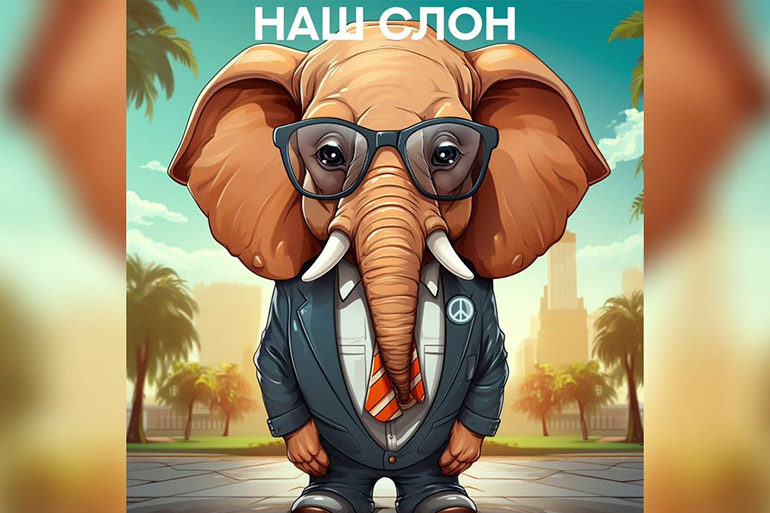
The image shows a large anthropomorphic elephant in a jacket, shirt, tie, and glasses, with the caption "Our elephant" above, and a background resembling a city avenue lined with palm trees. The suit and glasses make him look like a confident, important character — not like a specific historical person or an animal with an established biography.
One of our own or an ironic hero
In its literal meme usage, the author designates a person they sympathize with: someone who backed a familiar position, handled a task, or did something admirable. "Our" conveys a sense of belonging, while "big ol' elephant" lends the praise a rough-hewn force. In post-ironic versions, the expression might be applied to an unexpected figure or animal, making it sound both serious and absurd at the same time. The political coloring depends on the community and the target: the phrase has no single stable meaning across all contexts.
The suited image makes the character resemble a leader or public figure, but the word itself doesn't necessarily mean political support. A reader might see either sincere praise or a parody of fan-level admiration. So the caption needs to set the tone if the author intends to avoid ambiguity.
Who can be called your elephant
In a friend's chat after a successful repair: "Our elephant — showed up with a screwdriver and saved the shelf from falling a third time." Here the praise is exaggerated because the occasion is entirely mundane. For a shared project: "Our elephant — the coworker who noticed the months were mixed up in the spreadsheet." In this example, the image can be reinterpreted as a nickname for a competent team member, without tying it to any political stance.
Another option, for a photo of a tired cat: "Our elephant, who survived the trip to the vet and came back to sleep." The comedy rests on the grandiose praise given to a tiny hero. These are invented examples, not historical slogans or statements about specific public figures.
Clarify the context of the praise
The expression works for ironic praise of a friend, a character, or a team member. The local drawing by itself conjures an image of an important hero, so the caption can name the small achievement that person accomplished. If the subject is politics, it's worth keeping in mind the expression's original coloring and spelling out exactly what is being endorsed. Out of context, the meme might read as a serious marker of belonging to a community rather than a joke.
Don't attribute the phrase to a single, undisputed author: sources record one blogger's claim, but not a generally accepted, proven chain of origin. And don't use the word to justify violence or harassment of opponents. The friendly version works best when tied to a concrete deed, not to a person's appearance or background.