From character progression to everyday rating
The Elder Scrolls V: Skyrim came out on November 11, 2011; the game was developed by Bethesda Game Studios. The character develops skills by using them and gains access to new abilities. In the interface, the names of the abilities and the numerical values make it possible to see the level of mastery at a glance. Among them are Speech, Sneak, Destruction and other abilities tied to different playstyles.
The meme moves this measurable scale from the fantasy world into ordinary life. A successful excuse becomes Speech, an unnoticed action becomes Sneak, a sharp reply becomes Destruction. The game provides a short form of evaluation, and a photo or a story explains what it is awarded for. Sometimes a high number expresses genuine praise; sometimes it ironically rates an attempt so bad that it looks outstanding.
The “Speech 100” wave
Among the early known posts in this format is one in r/dankmemes dated June 18, 2017. To a video of a person passing off their flight as a jog, a Speech 100 rating was added. Then the names of other game skills started being used in a similar way. The date of this trace refers to a specific remake, not to the creation of the interface, which had appeared several years earlier.
The format proved convenient for short reactions under other people's stories. There was no need to make a complicated collage of one's own: the name of a skill could be used to comment on an action already seen. English versions kept the familiar game font and background, while Russian versions used translations or simply attached the rating in words. Recognizability rested on the combination of a skill name and a deliberately precise number.
Two lines at different scales
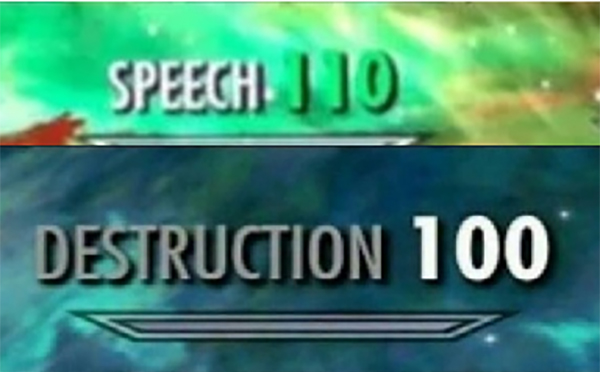
The top part of the image shows the inscription Speech 110 on a bright green background. Below is Destruction 100 and a long decorative bar resembling an element of the game interface. A division is noticeable between the parts; there is no photo of a person or a completed plot. This is a set of two meme ratings, not evidence of a single screen on which a game character received both scores at once.
The number 110 intensifies the exaggeration: it goes beyond the “hundred” limit customary for this family. In meaning, the pairing works well for a reply so convincing or sharp that it simultaneously demonstrates eloquence and destroys the opponent's argument. However, the second skill may also refer to a literal failure. The caption decides whether two sides of one action are rated in words or different results are being compared.
Three invented skill checks
The invented example “Explained that the broken cup freed up space on the shelf” gets two ratings: the speech sounds smooth, but the destruction really did happen. Another storyline: “Asked about the report's readiness, named the file ‘ready.’” This is ironic eloquence: the hero replaces the result with a name, as if a successful formulation solves the task.
A third variant: “A friend asked for a short review and got one sentence, after which I rewrote the whole story.” Here Speech and Destruction denote the force of a precise remark. All three stories are invented, and the ratings work as a closing comment. First the reader must see the action, then the scale: in that order, the game insert turns an understandable situation into an unexpected leveling-up scene.