The frame and the character
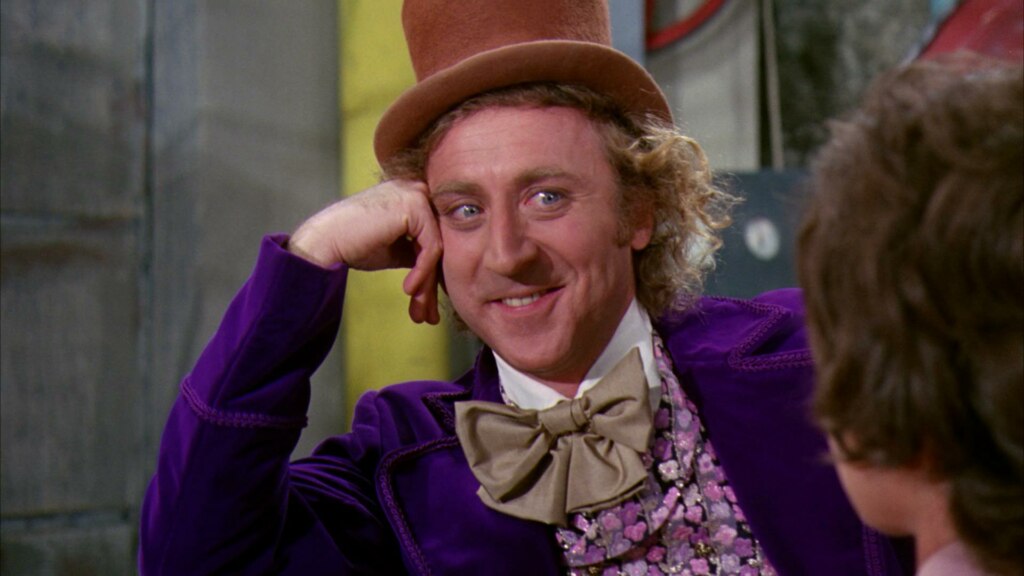
In the original frame, Wonka, in a brown top hat and a purple velvet coat, props his cheek on his hand and looks sideways at the person he's talking to with a sly half-smile. His gaze is sidelong, his posture relaxed, and it's exactly this mix of politeness and skepticism that became the basis of the meme.
The image was created by Gene Wilder in the 1971 film based on Roald Dahl's novel Charlie and the Chocolate Factory. The actor played Wonka as an ambiguous character, so his facial expressions read easily as ironic and suspicious, and that's exactly what makes the frame so useful for captions.
Origin of the meme
The meme dates to 2013. Condescending Wonka took shape on the English-language internet and quickly crossed over into the Russian-language internet, where it got the translation "go ahead, tell me." The exact first post and the author of the caption are unknown.
The frame is a scene from the film that users cut out and gave a caption to. The caption sets the tone, and it's exactly the caption that turns the scene into a meme. So the frame itself never changed, while the meaning was determined by the text added to it in every new case.
Meaning and use
The phrase expresses distrust of a person who's about to grab attention, tell a story, or share dubious information. The speaker is essentially warning in advance that he doesn't believe a word of it, and is waiting for the rest just so he can laugh at the possible lie.
In chats the meme is often used in reply to boasting, long excuses, or clearly made-up stories. It works gently: it's not a direct accusation but an ironic signal that the other person is trying a little too hard to sound convincing.
Variants and reworkings
The film frame is easy to rework: different captions get attached to it, from everyday ones to political ones, and the meaning shifts depending on the context. Sometimes the meme is used to mock overconfident predictions or loud promises that rarely come true.
There are also gentler versions, where the same pose signals that the other person is about to say something obvious. These reworkings show that the meme doesn't rest on a specific plot but on the character's recognizable expression, which reads without translation.
Cultural context
The meme belongs to a family of reactions in which well-known film frames serve to express emotion without words. Such images are valued because the emotion is clear even to those who haven't seen the film, while the caption only refines the shade of meaning.
The 1971 film became a classic of family cinema, and the image of Wonka became firmly embedded in pop culture. The meme shows how an old film keeps living on in internet speech and picks up new meanings decades after its premiere. It also matters that the frame itself requires no knowledge of the film: the pose and the gaze read instantly, which is why the picture stays understandable even scrolling fast through a news feed, where a caption has to be read in a second. That universality is exactly what explains why the meme is still in use years after its first appearances.