What's in the frame
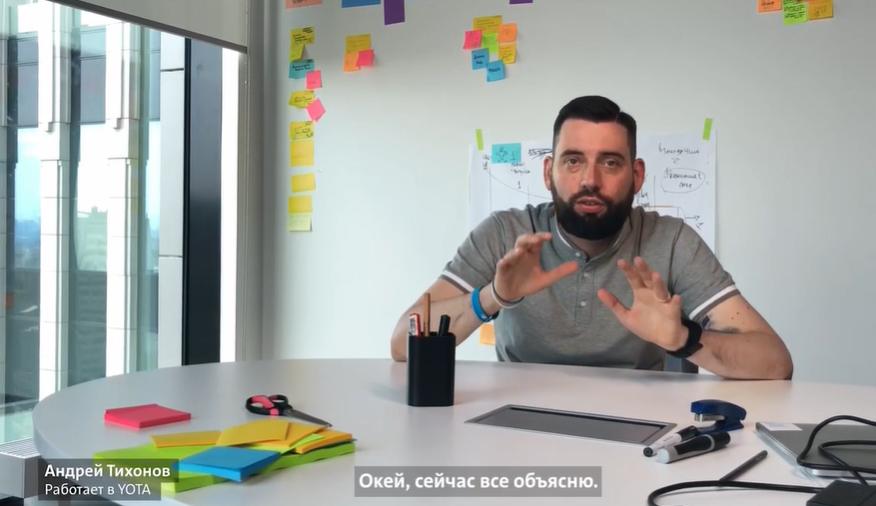
A bearded man in a gray polo shirt sits at a white oval table. Colorful sticky notes, scissors, a cup of markers and a stapler are scattered across the table. On the wall behind him, many colored sheets of paper are stuck up, and a sheet with sketches of diagrams hangs there. A cityscape is visible through the window.
The man looks into the camera, both hands raised and spread in a soothing gesture. A subtitle at the bottom reads “Okay, now I'll explain it all.” The screen also had a caption with a name and workplace, but these details are not named here: they refer to a specific person, and for the meme they carry no meaning.
What is known about the ad
The clip was made as part of an advertisement for the operator Yota. According to media reports, the company's ad campaigns featured real employees rather than actors. Which specific campaign this frame belongs to, and when it was released, is not reliably known, so neither a specific date nor the date the frame became a meme should be stated.
It is known that the ad format with employees looked “homey”: an office, a desk, a calm voice. It was exactly this everyday simplicity that let the frame escape the ad and into other people's jokes.
Why the frame became a template
The phrase “now I'll explain everything” is familiar to anyone who has heard an introduction before a long story. In the frame it is accompanied by a soothing gesture that emphasizes the speaker's confidence. The viewer instantly understands that something long is about to follow.
The stickers and diagrams behind him amplify the effect: the workspace is full of notes, so the explanation will be complicated. The ad here turns into a portrait of a person who is about to sort out something complex point by point.
Caption examples
“A teacher opening a presentation with ninety slides.” The promise of simplicity contrasts with the volume of material.
“My friend, when I asked why he has two hundred unread messages in his chat.” The line shows that the answer will be longer than the question.
“Furniture instructions: ‘Assembly will take ten minutes.’” An ironic reaction to the manufacturer's assurances.
“Me, when someone asked how my own spreadsheet works.” Self-irony: the author is not sure they can explain everything themselves.
Why the explanation joke is recognizable
The meme rests on a situation everyone knows: a person confidently promises to explain quickly and then drowns in long digressions. The stickers, diagrams and notes in the frame recall meetings and brainstorms, where a solution that looks simple at first gradually grows a pile of details, which is why this image took root so well in work chats and jokes about studying. The character himself remains neutral and looks neither funny nor unpleasant, so the caption does not target a specific person; it works with the most recognizable situation of a long explanation.
How to use the template
The meme fits when someone is about to explain something at length and in detail, and the listener is bracing to endure it. It can also be used as self-irony at the start of your own long message.
Captions work best when built around the contrast “announced as simple, turned out complicated.” Without this, the joke turns into a plain reference to the ad frame. The man in the frame is a real employee, so captions should not touch on his personality or appearance.