What happens in the frame
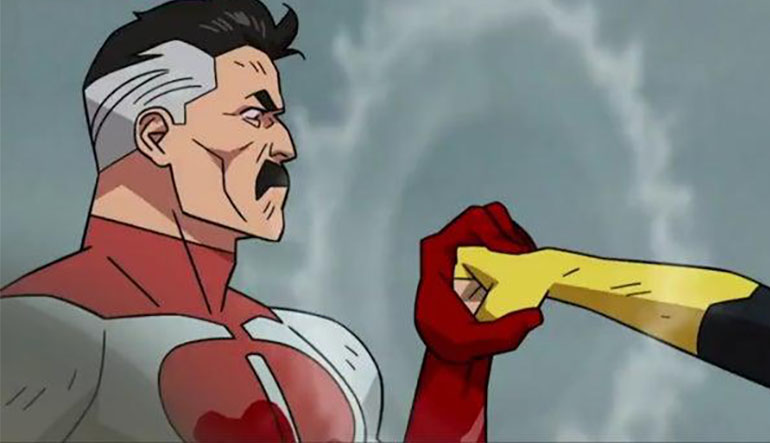
The image is a close-up of a man in profile with dark hair, a gray streak at the temple, a mustache and a stern, frowning gaze. He wears a red-and-white suit with a red patch visible on his chest. His red-gloved hand catches a yellow-gloved fist flying in from the right. The background is gray, with a ring-shaped cloud behind him, as after a powerful blow.
He does not look strained but irritated and confident: he doesn’t flinch or lean back, he simply holds the other person’s fist. That feeling of complete superiority is what makes the frame useful for a joke.
The episode the frame comes from
The frame comes from the animated series Invincible, based on the comic; the hero is Omni-Man, and the fist belongs to his son, Mark. The scene is from the final, eighth episode of the first season, released on April 30, 2021: in it, father and son clash in a fight, and Mark tries to punch Omni-Man.
The frame became a caption template a little later. According to an English-language meme reference, a ready-made version with labelable hands was posted on Reddit by the user u/AldousCarey4U on June 14, 2021, in a template community; the post got several thousand votes. After that the format spread through topic communities, including history and movie memes.
How the joke works
The meme works as a scheme with two roles. The one who catches is labeled as something strong, established or clearly superior. The fist is labeled as a weak attempt, a naive argument or an annoying threat. Viewers read the balance of power instantly, so all the caption has to do is name the participants.
It is funniest when the forces are objectively incomparable, or when the “weak” side looks aggressively overconfident: the blow looks strong, but it is simply caught. That is why jokes often pit loud promises against dull reality.
Caption examples
Left: “Deadline on Friday.” Right (the fist): “I’ll start Thursday night.” The deadline catches it effortlessly, and the sense of inevitability is clear to everyone.
Left: “Alarm clock.” Right: “Five more minutes.” A small delay meets the force that always wins.
Left: “Mom’s question, ‘Have you eaten?’” Right: “I’m not hungry.” The answer gets caught in any case.
Left: “A cat that wants to be held.” Right: “I have a lot to do today.” The setup is playful, because the winner is obvious in advance.
All the examples work the same way: the caption on the left sets an undeniable force, and the caption on the right sets overconfidence that ends exactly at the moment of contact.
Usage tips
It is best to label the frame with short nouns: two or three words for each hand read faster than full sentences. Avoid captions of similar weight, or the contrast disappears.
You can flip the joke: caption the catcher as something absurdly small and the fist as something menacing. The meme then becomes irony about an exaggerated threat. Viewers who don’t know the series don’t need the plot explained: the pose and expression read on their own.
Why this frame caught on
The frame has three qualities every template needs. First, a clear composition: two hands meet exactly at the center, and the eye immediately sees where the “force” is and where the “attempt” is. Second, a readable emotion: the hero’s grimace expresses not pain but annoyance, which gives the joke a “well, what did you expect” tone. Third, empty space: the template has no text, so it can be adapted to an argument of any scale, from school topics to discussions of technology and history.
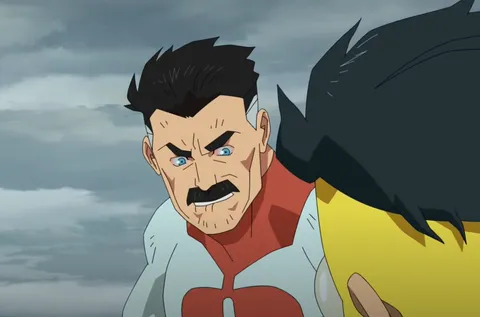
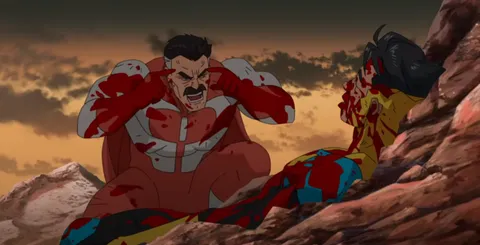
Because of this, the format also sits easily next to other scenes from the series: by the same principle people compare “before” and “after,” a promise and its outcome, a bad plan and a harsh reality check.