A line from Garik Krichevsky’s song
“Dyadya Tolik” is a song by Garik Krichevsky, author of both the music and the lyrics. In the song the request for a haircut already works as a memorable chorus; the online version pulls the line out of the narrative and keeps it as a standalone remark. In the song the request is addressed to a familiar barber, but the verses also tell a broader story of a man who left, returned to his hometown and remembers old acquaintances. The meme usually extracts the chorus from this narrative and leaves a short, easily recognized command.
How the request became a meme line
In everyday use the line has separated from the song’s plot. People repeat it when someone unexpectedly changes their hairstyle, jokes about shaving their head, or simply wants to give an ordinary trip to the salon the flavor of a courtyard joke. The rhythm helps the phrase live on its own: the address by name, the imperative request and the rhymed qualifier form an almost ready-made chorus. The exact first post with this phrase could not be established, but its short rhythmic chorus is easy to carry from the song into a caption for a new situation.
There is also a short variant where only the haircut request is kept. Then the address by name disappears, but the sharp demand remains. The full line sounds like a mini-verse, while the trimmed version is more like an instant reply: this makes the joke easier to fit into a conversation about changing one’s appearance. This is not a mandatory rule, just two natural ways of handling one phrase.
What the portrait adds
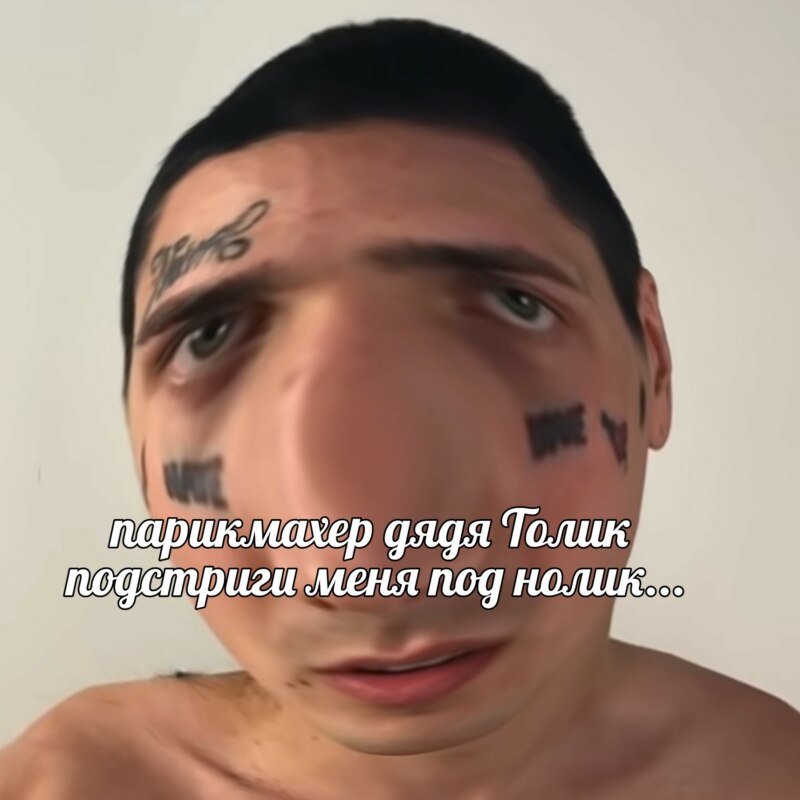
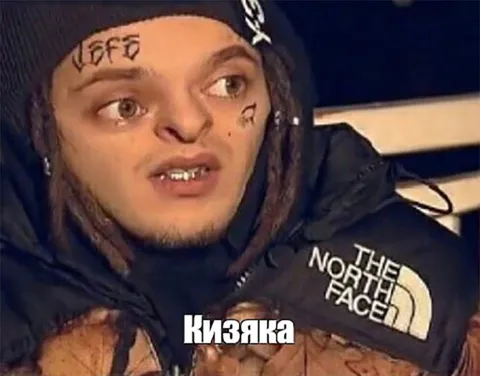
The picture shows a large male portrait taken close to the lens: the middle of the face is visually enlarged, tattoos on the forehead and cheek become a noticeable part of the frame, and the white caption fills the lower part of the image. This is neither an illustration of the song’s hero nor a photo of Krichevsky himself. The song request sounds over the portrait with distorted proportions, so the joke is built on the collision of a familiar song intonation with an unexpected face and an exaggerated closeness to the camera. The frame does not prove that the person shown is going to get a haircut or is really addressing a specific barber.
This portrait and the song line match in their exaggeration, although they come from different contexts. The photo shows a real human appearance, but the lens distortion changes the proportions of the face; it says nothing about the person’s character. Over such a portrait the phrase reads as a comic demand rather than a line the man actually says. This is the strength of the edit: a familiar chorus suddenly speaks directly to the image, as if the image were itself a visitor to the barbershop.
Invented captions
You could send the phrase to a friend who for the first time in years has decided on a short haircut: the old chorus instantly turns an everyday change into a small event. Another invented variant is a caption under a hat taken off after winter: “Barber, at least trim the border between hair and hood.” A third is a reaction to a filter that removed the hair in a photo: here the song request is unexpectedly carried out by a digital editor. These are new examples, not real posts or words of the person in the photo.