What the picture shows
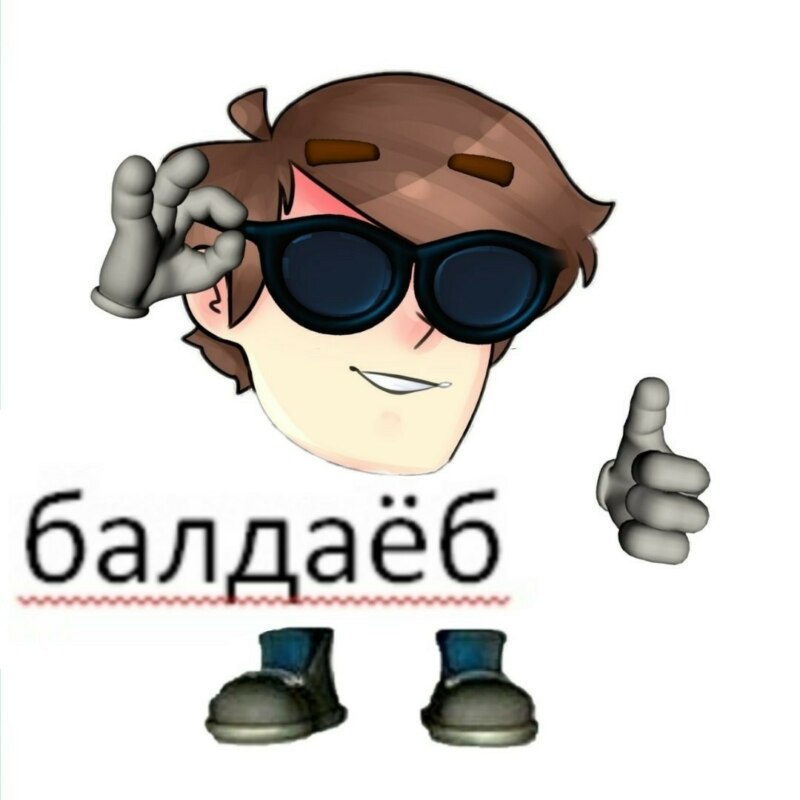
It is a digital drawing on a white background. A large head of a young man with chestnut hair falling over his forehead, ginger eyebrows and a wide smirk is drawn in the center. He wears round dark glasses in thick frames. His left hand, in a gray glove, forms a ring with its fingers and holds the glasses by the frame. His right hand is raised on the right side with the thumb pointing up.
Below are two dark-blue boots with gray soles, drawn separately, so the figure looks assembled from stickers. Between the head and the boots, large black lowercase letters spell the word “baldayob,” and beneath it runs a red wavy line, the kind a text editor uses to underline an unfamiliar word. This detail is part of the joke too: the word looks like both a typo and a deliberately invented one.
Where the word came from
The word is built as a phonetic distortion of a profanity. Softened variants like this often appear in internet speech: the crude meaning survives, but the form sounds almost childish, so it is taken as a joke. The meme is dated roughly to 2018 and is associated with VKontakte, where such words spread quickly through comments and communities.
This is where the comic contrast lies: a harsh meaning is expressed in a harmless form, while the character in the picture looks pleased with himself. How firmly the distortion became attached to any particular community is not established by open sources.
How comment spam works
The mechanics are simple. Under a new post one word appears, then another, and after a few dozen comments the feed turns into a stream of identical lines. The humor lies not in a storyline but in repetition: the viewer recognizes the familiar picture and understands that it is not a reply to the post’s text but a separate ritual.
The picture adds an image to the repetition. The glasses and the raised thumb create a sense of confidence: the character seems to say everything is under control, even though the word beneath him signals the opposite. The gap between the self-assured pose and the absurd word is what amuses. That is why the picture is posted as a reply even when it has nothing to do with the discussion.
Origin of the picture: what is known
The artist and the first posting of this picture are unknown. Explanations boil down to the word being a distortion, not the name of a character, an event or a specific blogger. So it cannot be claimed that the hero of the drawing is a known person or a character from some game: there is no basis for such a conclusion.
What is known is only what is visible in the image itself: a stylized young man in dark glasses, gestures of confidence, and a caption with red underlining. Everything else, including the artist’s name and the original context, remains unestablished.
Examples for your own caption
1. “Wanted to reply to the post, but apart from one word nothing came to mind.” The caption turns spam into a confession: the irony is that the reply is shorter than the queue to get to it.
2. “Waiting for someone to explain what I just read.” The red line from the picture becomes part of the question: the meaning of the word is in doubt, and the glasses look like a mask of confidence.
3. “My answer to the question of how the renovation went.” The example moves the template into everyday life; the sarcasm rests on the confident gesture not matching the situation.
In every variant the pose and the word argue with each other. If the caption just repeats the word, the joke disappears; it becomes funny when the caption explains why the word keeps repeating.
How to use the template
The picture suits short reactions and ironic replies in arguments where one participant is too serious. Don’t put it under someone’s real troubles or address it to a specific person: then a meme about a style becomes an insult. For a neutral joke, one line of text next to the image is enough.