A cloud with a face
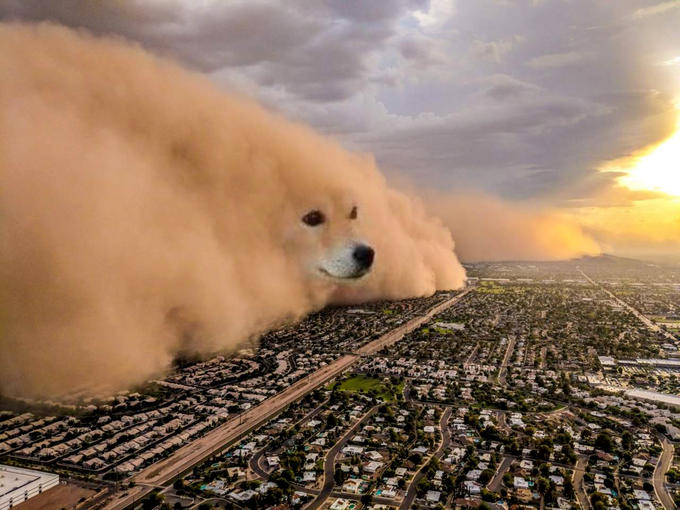
The picture is shot from above. Below, straight streets and tidy blocks with identical rooftops fan out, with a strip of greenery and a few large buildings. On the left, a dense reddish-brown wall of dust rises almost from the ground to the sky, blocking out a large part of it, while yellow sunset light breaks through on the right.
A dog's face has been inserted into the head of this wall: a black nose, a dark eye and ear, light-colored fur around the muzzle, and a slightly open mouth. The expression is peaceful, almost affectionate. The breed looks like it could be a Shiba Inu, but that can't be determined for certain, since only part of the muzzle is visible.
Where the original photo came from
The original is an aerial photograph of a dust storm approaching Phoenix, Arizona. The photographer is credited as helicopter photographer Jerry Ferguson, and the shot is dated August 2, 2018. Such phenomena in desert regions are called haboobs: strong wind kicks up an enormous column of dust and sand.
The picture in this entry isn't a straight photograph but a photoshop. According to English-language sources, the earliest known version with the dog's face appeared that same day on Twitter, posted by a user going by @chopperguyt. Later, in November 2019, a version called "haboob doggo" was posted on Instagram, and interest in it picked up again. Who exactly edited the dog in first can't be reliably established: cases like this often have several independent versions.
Why it worked
The photoshop is built on a simple contrast. On one side is a destructive force of nature, usually discussed in serious terms. On the other is a harmless little face that makes it look like a giant, good-natured pet. The brain immediately fills in the rest of the picture: the dog is bounding over the streets and might just want to play.
There's another layer of meaning here: in this form, the phenomenon loses its threatening character — a wall of dust with a good-natured face reads not as a force of nature but as a big dog that simply misjudged its own size. Still, it's worth not forgetting the real consequences of such storms: they're dangerous for people and vehicles.
How the meme evolved
Later on, people started adding labels spelling out what the picture "represents." According to foreign sources, one of the first known labeled versions appeared on Reddit on December 30, 2019, and in late January 2020 a version with captions referencing a popular song racked up hundreds of thousands of likes on Twitter. The "labeled diagram" format suits the template well, since the frame has distinct parts: the wall, the neighborhood, the green patch, the sunset.
The template fits easily into familiar scenarios about problems that all arrive at once, and into jokes about something enormous engulfing something small and tidy.
Example captions
Over the dust wall: "Work problems"; over the neighborhood: "Me, who was planning a quiet day." This is simple role-swapping at work: the enormous versus the small.
Over the face: "He just wants to be petted." The caption draws attention to the cute face, while the scale of the whole scene makes the joke absurd.
"My cat when I got up a minute late and the bowl is already empty." An everyday pet complaint blown up to the scale of a natural disaster.
"Taxes that show up at the end of the year." The image of an unstoppable force gets transplanted onto another topic, where the dog's face looks harmless but the consequences are very real.
Tips for using it
The template works best for comparing scale: a huge amount of something against a single person or a small neighborhood. Don't caption it with real tragedies tied to weather disasters: the effect rests on the comic softness of the face, not on dismissing real danger.
The city itself can also be labeled: the green square, the long road, the row of identical rooftops. The more details get their own captions, the funnier the serious breakdown of a not-at-all-serious picture looks.